Almost half of email subscribers’ decisions to open an email are based on the subject line alone. This means, for the average Shopify store sending 2-4 emails per week, your subject line is the most frequently occurring sales pitch for your brand. It costs nothing to improve, takes only a few seconds to do, and can determine whether or not your subscribers even get to read the campaign you worked so hard to create.
Yet, many ecommerce brands are still using boring, bland subject lines like “New Collection Alert,” “Our Latest Products,” or “Check This Out.” They’re going to get lost in the noise, generate zero clicks, and bring down your entire email marketing campaign.
To make matters worse, Apple’s Mail Privacy Protection has made it harder than ever to accurately track open rates, so you’re going to have to use better writing—rather than guesswork—to grab subscribers’ attention from the very first moment.
The bar has been raised, and this is actually great news for you. Your competition is still writing boring subject lines, but you now have the chance to stand out in every inbox, for every send.
This guide will walk you through the psychology behind these decisions and the five elements of ecommerce subject lines, including 30+ examples you can use today, common mistakes to avoid, and how to run A/B tests for subject lines. By the end of this article, you’ll know exactly how to write subject lines that get the open every time.
Why Subject Lines Matter More Than You Think
The majority of emails today are being opened through devices like smartphones and represent more than 60% of all email opens. This means there are two major limitations that most brands do not consider. First and foremost, only 35-40 characters of your subject line will be shown to the user before it is cut off. Secondly, users only spend less than 3 seconds scanning through all the emails in their inbox before deciding what to do with each email.
This means that your subject line must do three things at once: it must stand out in terms of aesthetics compared to dozens of other competing subject lines in the user’s inbox, it must clearly communicate its benefits in only a few words, and it must persuade the user to tap it.
It is not successful at any of these three tasks, then the rest of your email is irrelevant and useless. Your design, copywriting, offer, and images are all irrelevant if no one opens it in the first place. Your subject line is essentially the gatekeeper of all email marketing efforts and is arguably the most crucial part of it all. One more thing to consider is that subject line performance is actually related to how well your sender reputation is performing. This means that if people do not open your email, it is likely that future emails will end up in spam. Understanding how to create subject lines that actually drive opens is not only a conversion tactic but is actually part of how you avoid ending up in spam in the first place.
Open Rates in the Apple MPP Era
This is because Mail Privacy Protection loads content automatically, which means there is a huge inflation of open rates. It is possible to have people counted as opens who never really saw the email in question. As such, open rates are becoming an unreliable means of judging the success of subject lines.
What you should do today is avoid using open rates as part of your subject line tests and instead opt to use click-through rates (CTR) as your secondary metric. This is because CTRs are more reliable and give you insight into actual engagement, which is what you are trying to optimize.
If you want to understand more about why email open rates are not reliable and what you should be using instead, this context will change everything you think about judging the success of your subject line tests.
The 5 Subject Line Levers for Ecommerce
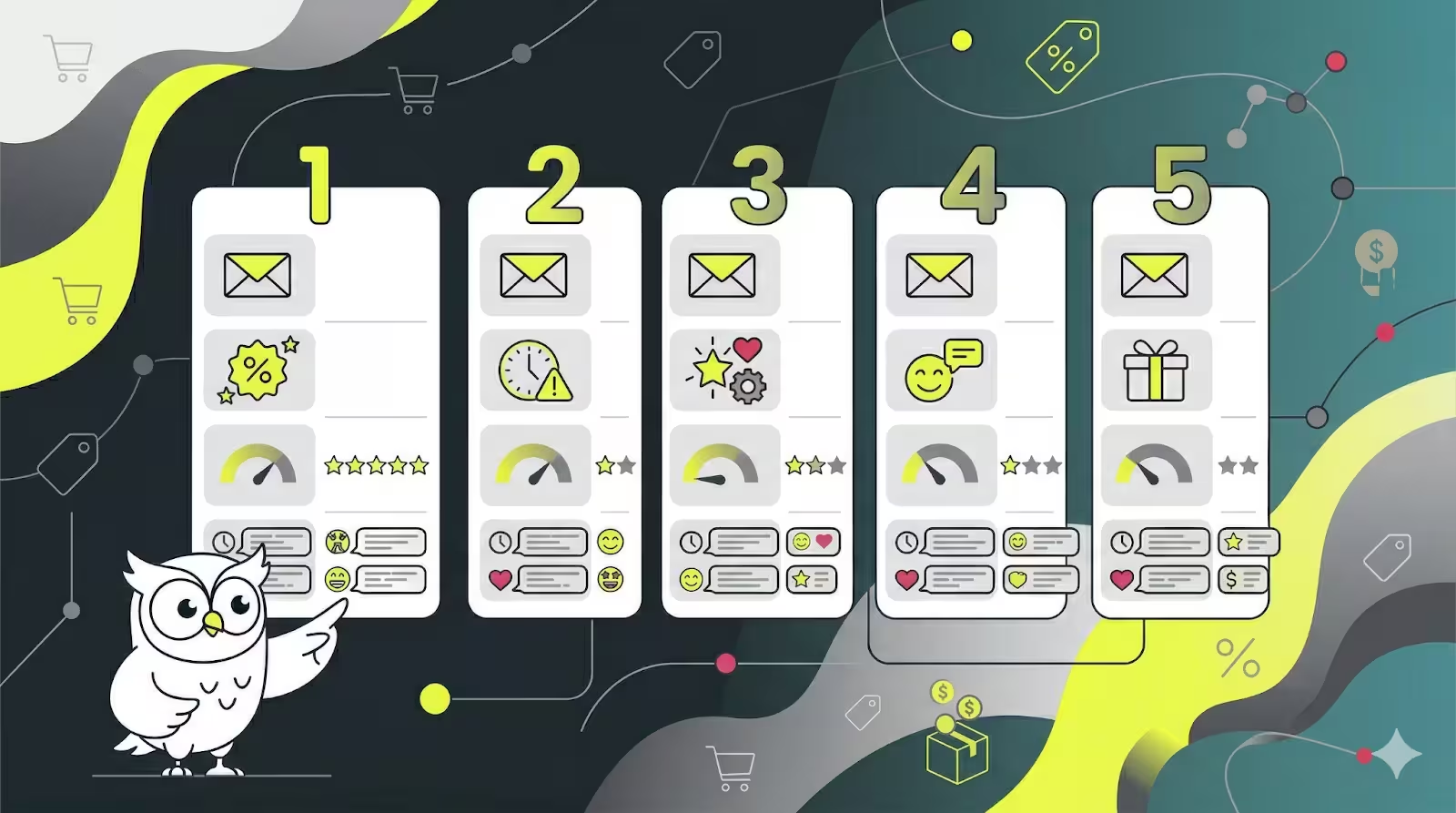
The top-performing ecommerce subject lines rely on one of five psychological drivers. The five drivers are:
Ecommerce subject lines under 40 characters boost mobile open rates by 12-15% compared to those over 60 characters.
Lever 1 – Curiosity
The driver of curiosity is to create a gap in information that prompts the reader to open the message to get more information. This is a great tactic for newsletters, product stories, and brand communications where you have something interesting to share.
Examples of curiosity-based subject lines:
“We tested 3 pricing strategies. One tripled AOV”
“The product we almost didn’t launch”
“Something surprising happened yesterday”
The critical requirement for using curiosity is to make sure you deliver on the promise of the subject line. If you don’t deliver, you lose credibility fast, and people unsubscribe in droves.
Lever 2 – Urgency & Scarcity
The driver of urgency is to create a sense of fear of missing out. This is a great tactic for flash sales, limited stock notifications, and cart abandonment messages.
Examples of urgency-based subject lines:
“Your cart expires in 2 hours”
“Only 14 left at this price”
“Flash sale – gone by midnight”
Studies have found that using urgency-based subject lines boosts open rates by 22%. The critical requirement for using urgency is to not use it unless you mean it. If you say something ends tonight, it has to end tonight. The reason is that people remember being lied to for a long time.
Lever 3 - Personalization That Goes Beyond First Name
While personalization with first names used to be effective for open rates, it’s no longer enough. What really makes a difference is talking about actual behavior: what they looked at, what types of things they looked at, and what they bought last time around. For example: “Sarah, those sneakers you looked at last week are 20% off,” “Your favorite moisturizer is back in stock,” “Still thinking about that leather backpack?”
To use personalization in a subject line like this, however, it’s essential to have actual email list segmentation. “The effectiveness of the subject line will depend on the customer data it’s built around. Segmentation of email lists and subject lines should be thought through in parallel and not in isolation.”
Lever 4 - Specificity and Numbers
Numbers and specificity give people clarity and trust in a way that vague language and generic terms never can. For example: “Big savings inside” (not effective) vs. “25% off all winter jackets” (effective). This is because it’s easy to understand at a glance and leaves no room for misinterpretation. For example: “5 outfits under $50,” “Our bestselling for only $12.99,” “3 recipes with our spice kit.” These types of subject lines use specificity and numbers to get people’s attention and create a sense of respect for people’s time.
Lever 5 - Benefit-First Framing
This lever is all about putting the benefits for the customer first. Ask yourself: “What is this email going to solve for my customer?” Start with that. For example: “Sleep better tonight with our new arrivals,” “Get free shipping for all your weekend essentials,” “Stop guessing your size with our new fit quiz.” By putting benefits first, it’s easier to focus less on ourselves and more on the customer.
30+ Subject Line Examples by Email Type
Cart Abandonment Subject Lines
- Still thinking about [Product]?
- Your cart is feeling lonely
- Complete your order — free shipping added
- Did something go wrong? Your [Product] is waiting
- Last chance: your cart clears in 24 hours
- A little nudge: [Product] is selling fast
Flash Sale Subject Lines
- 40% off everything — 6 hours only
- The sale your wishlist has been waiting for
- This deal ends at midnight
- Our biggest sale since BFCM
- Free gift with every order today
- Price drop alert: [Category] just got cheaper
Welcome and Post-Purchase Subject Lines
- Welcome! Here's 10% off your first order
- Your order is confirmed — here's what happens next
- Thanks for your purchase. You might love these
- You're in! Here's what to expect
- Your [Product] ships tomorrow
- Quick favor? 30-second feedback survey
Building a strong welcome email sequence starts with the subject line. A new subscriber is most engaged in the first 24–48 hours, and the right subject line during that window can set the tone for the entire customer relationship that follows.
Newsletter Subject Lines
- 3 things we learned from our best month ever
- The skincare routine our founder swears by
- What 500 customers told us
- New drops + behind the scenes
- A brutally honest product review
- The email your inbox actually needs today
Win-Back Subject Lines
- It's been a while. Here's what you missed.
- We miss you — here's 15% off
- A lot has changed since your last visit
- Still interested in [Category]?
- Your favorites are on sale
- Should we stop emailing you?
Win-back subject lines sit within a broader re-engagement campaign strategy that goes well beyond a single email. The subject line gets the open, but what comes after determines whether that inactive customer returns for good.
Subject Line Mistakes That Kill Open Rates
The Spam Trigger Trap
There are things you can do which can kill your deliverability. For example, using all caps, too much punctuation (!!!!), and using language that is misleading are all common offenders. Using words like "free" is not, in and of itself, an indication of spam anymore, as modern spam filters are more concerned with your sender reputation than the actual wording of the email. The misleading subject lines "RE:" and "FWD:" are attempts to initiate a conversation, which is just plain false. These tricks are violations of CAN-SPAM and can destroy trust in an instant. These tricks can destroy your sender reputation faster than just about anything else.
The Clickbait Trap
Clickbait might give you a temporary spike in opens, but it is secretly sabotaging your list quality in the background. If the content does not live up to the promise of the subject line, subscribers will complain and unsubscribe. This is sending negative signals to ISPs. A temporary spike in opens is just not worth it in the long run. Your email list is an asset you have spent months building and is vulnerable to being ruined in just days.
The Generic Trap
Generic subject lines are completely uninformative. Using subject lines like "New Arrivals," "Don't Miss This," and "Special Announcement" are completely uninformative and are just another example of thousands of other companies sending similar emails into the same inbox at roughly the same time. What sets them apart? Nothing. Using specificity is key. Using specificity is essential to writing a compelling subject line. For example, using numbers, product names, and deadlines can turn an uninformative subject line into one worth opening.
How to A/B Test Subject Lines the Right Way
Testing subject lines is not negotiable if you wish to actually make progress instead of continuing to spin the same ideas. How to test subject lines is not a complicated process. Simply test a variable individually, split your list into two groups, A and B, with 20 percent in each group, and then automatically send the winning version to the remaining 60 percent of your list after 2 to 4 hours.
What to test in subject lines: Emojis or not, question or statement, short or long, curiosity or urgency. None of these are arbitrary examples. Each of these is a legitimate question that you are actually trying to answer in your marketing strategy.
Because of Apple’s MPP, it is important to factor in those opens when you are analyzing results and to tie it with CTR in case of a draw. Another important thing to remember is to test various campaign types, as what works in cart recovery may not work in newsletters or win-backs. Each of these groups requires a unique strategy, and only testing can help you determine what works best for your business.
Once you have a tested and proven methodology in place, you can then integrate this into your email marketing automation to run these tests automatically.
Writing Better Subject Lines with PushOwl
Writing effective subject lines becomes even easier when you have the right tools for the job. The email composer at PushOwl, for instance, has AI-based suggestions for subject lines that examine your message, message type, and target audience to produce a list of relevant suggestions. This helps you get over the dreaded blank page syndrome that often affects marketers trying to craft effective emails.
Additionally, you can use PushOwl’s built-in A/B testing for subject lines. This ensures that you send out a number of variant emails to a test group of subscribers and then automatically send out the winning variant to the entire list. This helps you stay in continuous motion without interruptions.
Regarding personalization, PushOwl’s system allows you to segment your subscribers according to their purchase history, location, level of engagement, and other criteria. This is what enables you to implement Lever 3 – behavioral personalization – for stores of all sizes.
Finally, in case you are sending out a flash sale message, PushOwl’s system ensures that you reinforce your message in web push notifications and SMS at the same time. This ensures that your subscribers get your strongest possible subject lines even in cases where your emails are not effective.
Conclusion
Great subject lines are not about tricks and tricks alone. Great subject lines are about combining the right psychological trigger—curiosity, urgency, personalization, specificity, and benefit—with content that accurately represents the content of the message. And when those two things come together, opens happen.
What really sets winning brands apart from those that don’t is their willingness to put testing first. Every audience is unique. What works amazingly well for one Shopify store might not work as well for another Shopify store with a completely different audience, category, and sending schedule. The only way to know for sure what works best for your audience is to run disciplined A/B tests and let data dictate everything.
Start testing your subject lines today. Start building this habit. The long-term benefit of increased opens, clicks, and revenue is well worth the effort.hat is goo