.png)

Introduction
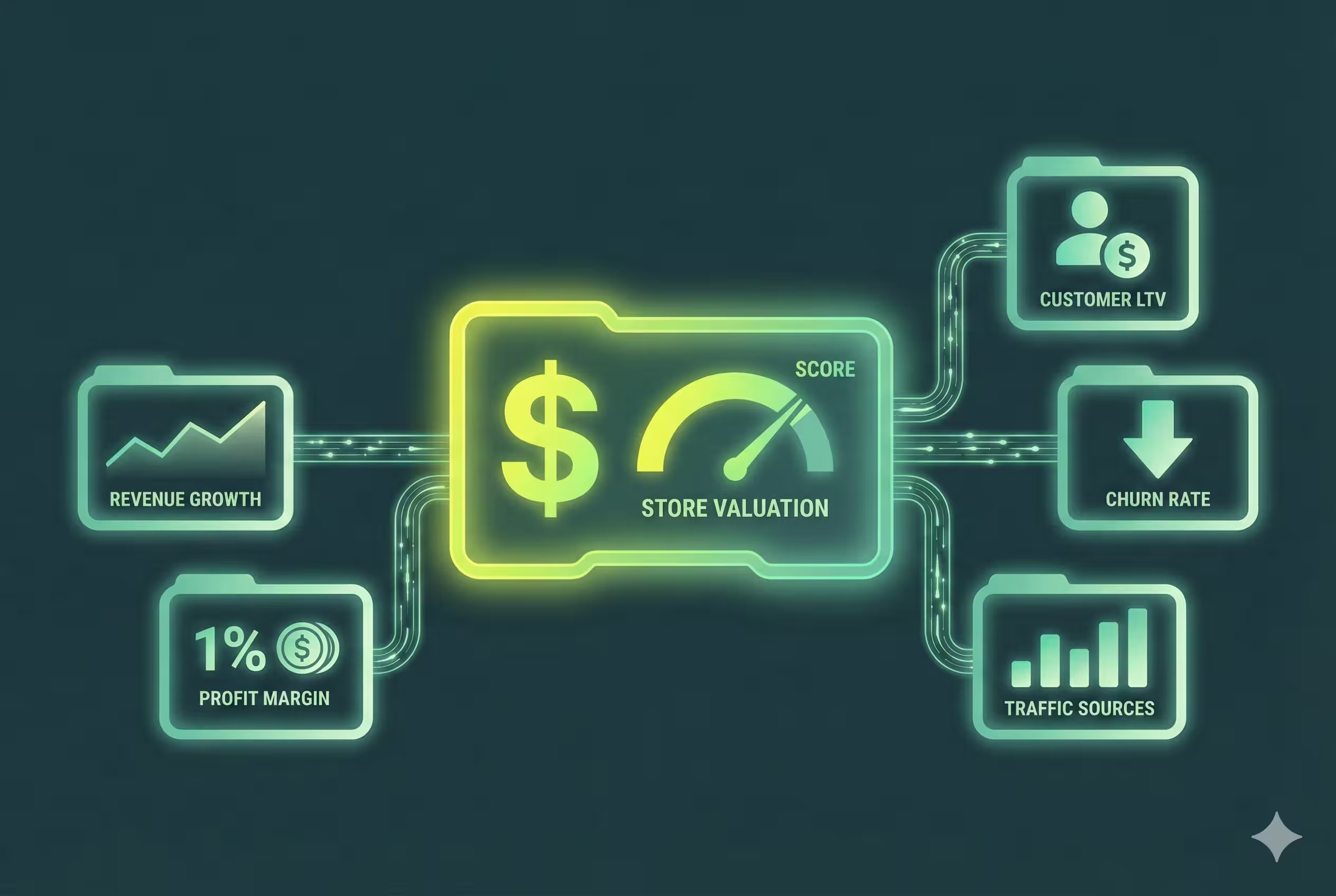
If you own or run an ecommerce business, understanding what it is worth is very important. This value is calculated and determined by ecommerce company valuation metrics, which essentially refer to the specific numbers as well as the performance indicators of your business. In this blog post, we will see the key financial and customer metrics that directly influence your company's valuation in 2026. We will also understand what investors and buyers evaluate to understand a business, which goes more than just the revenue.
Revenue-Based Valuation: The Starting Point for Your Store's Worth
When valuating your business, revenue-based valuation serves as the important first step. This method makes use of known industry multipliers that are applied to your sales figures to find a basic valuation for the company.
Gross Revenue Multiples (2.5x–5x): Where Your Growth Rate Shows
The main starting point, you can say, for valuing an ecommerce store is the gross revenue. Here, the analysts use a standard industry multiplier, called a revenue multiple, on your annual sales total, which also gives them a basic company valuation.
The specific multiple, which ranges from 2.5x to 5x, is based on your growth path. If your business has a strong, steady year-over-year growth, it can achieve a multiple at the higher end of this range. On the other hand, a store with stable but slower growth usually fits a lower multiple. Thats why, actively boosting your sales growth is one of the most straightforward ways to improve your business’s core value, because it can then directly raise the valuation base.
Net Revenue Multiples (1.5x–4x): Understanding the Metrics After Returns
To understand a more accurate and practical financial status of your business, though knowing the gross revenue is a starting point, the net revenue better represents it. This figure is your gross revenue minus all refunds, returns, and payment processing fees, and shows the actual income retained by your business. Investors here prioritize this metric because it shows your operational efficiency.
A higher net revenue multiple, which is within the 1.5x–4x range, shows a healthy business operation with very little financial wastage or leak. You can improve this key metric by reducing any post-purchase friction. For example, by using clear, automated order and shipping confirmation messages, you can manage customer expectations and decrease any inquiry-related support. Also, when you add more efforts by recovering abandoned carts directly recovers sales that would have otherwise been lost, thus improving your net revenue health and making your business more attractive for valuation.
Profitability Metrics: Measuring Your Real Business Health
After expenses, what your business mainly earns is revealed by the profitability metrics. It can tell more than just your past revenue and assess your actual financial health, and can directly influence the buyer’s perception of your business's value.
EBITDA Multiples (4x–8x): The Main Standard for Operational Efficiency
When it comes to measuring your core operating profit, EBITDA calculates it as Earnings Before Interest, Taxes, Depreciation, and Amortization. This amount usually does not count any external factors to show your business’s fundamental earning power from the daily operations, where the investors also value this clarity.
The store, which has a strong and a predictable EBITDA, can easily be valued at a multiple between 4x and 8x of this annual number. For businesses with efficient systems and scalable models, this EBITDA multiple will be higher, as they present very less risk. Thats why if your business shows that it is a transferable asset, and not solely dependent on the owner's personal efforts, it will show a strong EBITDA, which is a key goal for maximizing the valuation.
SDE Multiples (2x–4x): The Owner's Insight for Smaller Stores
For businesses that are owner-operated, Seller's Discretionary Earnings (SDE) is an important statistic to consider, which shows the total financial advantage the owner gains from the business throughout the year. It includes the business's net profit, the owner's salary, benefits, and all other non-essential expenditures.
This amount serves as the main foundation for valuing many small to mid-sized Shopify stores, and this valuation is generally a multiple of SDE, which ranges from 2x to 4x. To grow your SDE, you can improve your customer metrics by increasing lifetime value without greatly increasing your workload, thus improving your store’s valuation from this important viewpoint.
Customer Metrics: Your Business’s Most Valuable Asset
The quality and loyalty of your customer base is mainly assessed using customer metrics, and these indicators often matter more than total sales, as they predict future earnings and minimize your business risks.
The CLV:CAC Ratio (>3:1 is Ideal): Calculating Efficiency
The total amount of revenue you expect from a customer during their relationship with your store is the customer lifetime value. And the customer acquisition cost is the amount you spend on marketing to attract one new customer, so the CLV:CAC ratio compares these two values.
Here, the values for the ratio of above 3:1 is a strong indicator of effective growth for your business, as it shows that you earn over $3 for every $1 spent on acquiring customers, showing that your business model is sustainable and growing.
Having a high ratio can decrease the perceived risk and lead to a higher valuation. As it can be hard to cut CAC, it is a good tactic to improve your CLV with customer retention methods like targeted email flows and win-back campaigns, which raise a customer's value over time.
Repeat Purchase Rate (>30% Calls for a Premium)
The percentage of your customers who make a second or subsequent purchase at your Shopify store is the repeat purchase rate, which helps you directly measure the customer loyalty and satisfaction. Having a high rate validates your product-market fit for your business and can turn your one-time buyers into a reliable revenue stream.
During company valuation, this rate metric can be very helpful, as it helps build predictable future sales for your store and significantly lowers the ongoing cost of sales, because retaining a customer is cheaper than finding a new one. A store with more than 30% of returning customers is regarded as a solid and established brand that has a loyal following. This stability and recurring revenue model helps you guarantee a considerable increase in your business’s overall valuation.
Growth Metrics: Understanding Your Store’s Future Potential
To evaluate how your business is advancing and its potential for the future, you should use the growth metrics. Having consistent and predictable growth over the years is very appealing to investors, as it indicates scalability and decreases uncertainty when it comes to your business.
CAGR (>20% YoY = 1.5x Uplift): Having a Consistent Momentum
You can measure your business’s steady growth rate year after year over a certain time frame, with the compound annual growth rate. It removes the ups and downs of monthly changes to reveal a clear pattern. And for ecommerce valuation, a CAGR above 20% is a strong indicator.
This kind of steady growth shows a good and properly achieved market presence and the ability to scale operations. It can also greatly boost your valuation, often applying a multiplier of 1.5x or higher to your valuation base, as the most valuable growth for your business is the kind that lasts. Thats why your growth, driven by high customer lifetime value and a strong repeat purchase rate, is more stable and appealing to buyers than growth that only relies on any ongoing new customer acquisition efforts frequently.
MRR Growth- For Subscription & Membership Models
The reliable income a business expects to earn each month from its active subscriptions or memberships, can be termed as the monthly recurring revenue for the business. This metric is important for any D2C brands that usually sell types like subscription boxes, software, or membership programs.
This is highly valued it provides a consistent outlook on revenue, and its predictability can help you greatly decrease risks for your business. Thats why companies with rapidly increasing MRR often receive higher valuations, which can sometimes be between 5x to 10x of the annual revenue. It is important to protect this revenue stream, and automated communication, like renewal reminders and engagement sequences, can help to reduce the churn and steadily grow your MRR over time.
Shopify Store Specific Valuation Factors
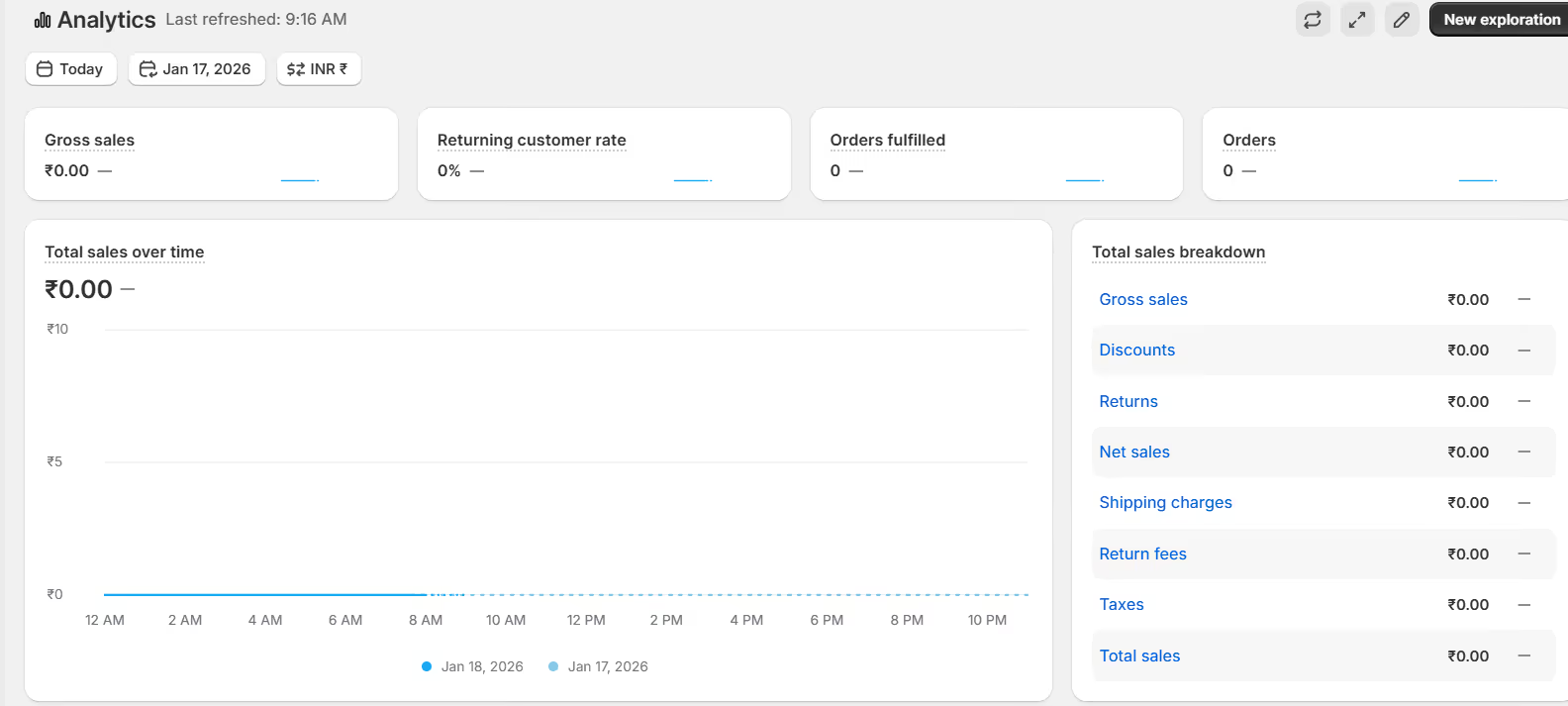
https://admin.shopify.com/store/riya-store-26-apr/analytics
The factors related to your Shopify store's valuation mainly deal with different elements that are particular to the platform. These details can improve and increase your store's value or also pose risks that need to be addressed in your dashboard.
App Store Revenue- Higher Multiples for Built-for-Shopify Businesses
If your business earns money by creating and selling a Shopify app, it gives you a unique advantage in valuation. This model uses the Shopify ecosystem and also benefits from the platform's steady growth.
Remember, the revenue from a successful app is generally recurring software or a SaaS income. This revenue type is highly valued as it is viewed as a scalable, predictable, and defensible income in a large, established market.
That's why businesses with app store revenue usually receive higher valuation multiples than the standard ecommerce stores, and this premium shows that the perceived lower risk and increased growth potential associated with a software-based model on a leading platform.
Theme and App Dependencies- A Risk Factor to Manage
When valuing your Shopify store, one of the risks can be when the store is depending too much on custom themes or specific third-party apps for its important functions. This dependence can be a warning sign during due diligence, as it may make transferring the business to a new owner more complicated and raise future expenses for them over time.
To reduce this risk and improve their valuation chances, it is best to keep a clean and well-documented tech stack. So, using apps with dependable, standardized integrations can be very helpful. For example, a platform like PushOwl is built exclusively for Shopify and provides a simple one-click integration, which shows that your main marketing functions are reliable, easy to move, and not dependent on weak custom code.
Putting It All Together: From Metrics to Your Valuation
So, before the valuation of your store, understanding these metrics is the first step. The next step is to use them to calculate your store's current value and create a plan to strategically increase it over time.
Your Action Plan To Calculate and Improve Your Valuation
Step 1- Audit your existing store metrics: You should start by collecting the financial and customer information for your store, and collecting your total gross and net revenue. Now, calculate your SDE or EBITDA, and identify the most important customer metrics such as the CLV:CAC ratio and repeat purchase rate. This review will give you the initial company valuation baseline to start with.
Step 2- Find your main levers: Now, you should look at your current metrics and compare them to the premium benchmarks that are mentioned, for example, CLV:CAC > 3:1, or repeat Rate > 30%. You need to now identify the one or two metrics that have the biggest difference. For many stores, the most impactful metrics to improve are usually in the customer metrics category, as they directly contribute to the sustainable profitability and growth of the business.
Step 3- Set up automated systems needed: To improve or boost these metrics, doesn't require more hours of work. You need to establish automated systems that support better customer relationships. Using and implementing proper omnichannel marketing, specific tools made for Shopify, can help automate this tailored communication. This method increases customer lifetime value and your shop’s repeat rates steadily over time, plus directly enhances your valuation.
Exclusive Resources for your Shopify Valuation
To simplify this process, you can use this easy and quick Shopify valuation calculator template, which lets you enter your key metrics. You input your numbers for revenue, profit, growth rate, and customer health. The template then uses the standard industry multiples mentioned to create a customized valuation range for your business.
Instructions to follow for the valuation calculator: You can copy the tables below into a spreadsheet like Google Sheets or Microsoft Excel, and input your own business data in the "Your Input" column for Section A. Next, the "Estimated Valuation Range" in Section B will be calculated automatically according to the formulas and industry multiples from this guide.
Section A: Input Your Business Metrics
Section B: Your Estimated Valuation Range
Here you can calculate a value that is based on different methods. Your final valuation will be typically be a range that considers all these results.
How to use this output for your Shopify store:
- You need to first look at the three dollar ranges, which are Gross, Net, and SDE, as these form the core of your valuation.
- If your CLV:CAC Score is above 3, it supports using the higher end of those ranges.
- If your Repeat Rate is above 30%, it also supports a higher valuation for your store.
- If your Growth Rate is above 20%, you should definitely consider applying an uplift to your core range and improve the numbers for your store.
Remember that your final estimated value is not one number, but will be a range, for example, $150,000 to $300,000, that blends these results based on your business's advantages.
Using and Implementing the PushOwl Export Advantage
You can now fill this calculator with all the accurate, real-time data about your store. To help you, PushOwl's advanced analytics dashboard provides clear reports on essential customer metrics, such as your repeat purchase rate and segment performance. And now, exporting this information guarantees that your valuation calculation is based on data, not just an estimate, which actually reflects your actual store performance.
Final Note
The value of your Shopify store clearly shows its financial status and customer loyalty, and by concentrating on the metrics mentioned, like revenue and profit, customer retention, and growth, you create a more valuable and sellable asset. Improving these numbers is easy and effective with the right systems.
A platform like PushOwl provides the required and efficient automated tools to directly increase your key valuation drivers, such as customer lifetime value and repeat purchase rates. So here, start by auditing your metrics, then implement the strategies that strengthen your business fundamentals for your long-term worth that you are looking to grow.