
Fashion brands rarely choose an email platform in a vacuum.
They choose it when the spring drop is two weeks away, when abandoned carts are piling up, when size-specific back-in-stock alerts matter, or when a founder realizes their “simple newsletter tool” is no longer enough for a growing catalog. That is why Shopify Email vs Klaviyo for fashion brands is not really a generic software comparison. It is a growth-stage decision.
For apparel and accessories stores, email has to do more than send campaigns. It needs to support collection launches, visual merchandising, segmented promotions, restock alerts, price-drop journeys, and category-specific browse recovery. At the same time, cost control matters. Shopify Email is attractive because pricing is straightforward: the first 10,000 emails each month are free, and additional volume starts at $1 per 1,000 emails. Klaviyo, by contrast, is built around richer segmentation and automation, but its billing is tied to active profiles and usage, which can become expensive as a fashion list grows. Shopify Help, Klaviyo Pricing
So which is the better fit?
The short answer: Shopify Email is often enough for early-stage fashion brands that need simplicity, tight Shopify integration, and predictable sending costs. Klaviyo makes more sense for apparel brands with larger catalogs, more sophisticated segmentation, and heavier automation needs. But there is also a third path: brands that want retention across email, push, and SMS without stitching together a bloated stack should consider an omnichannel option like PushOwl.
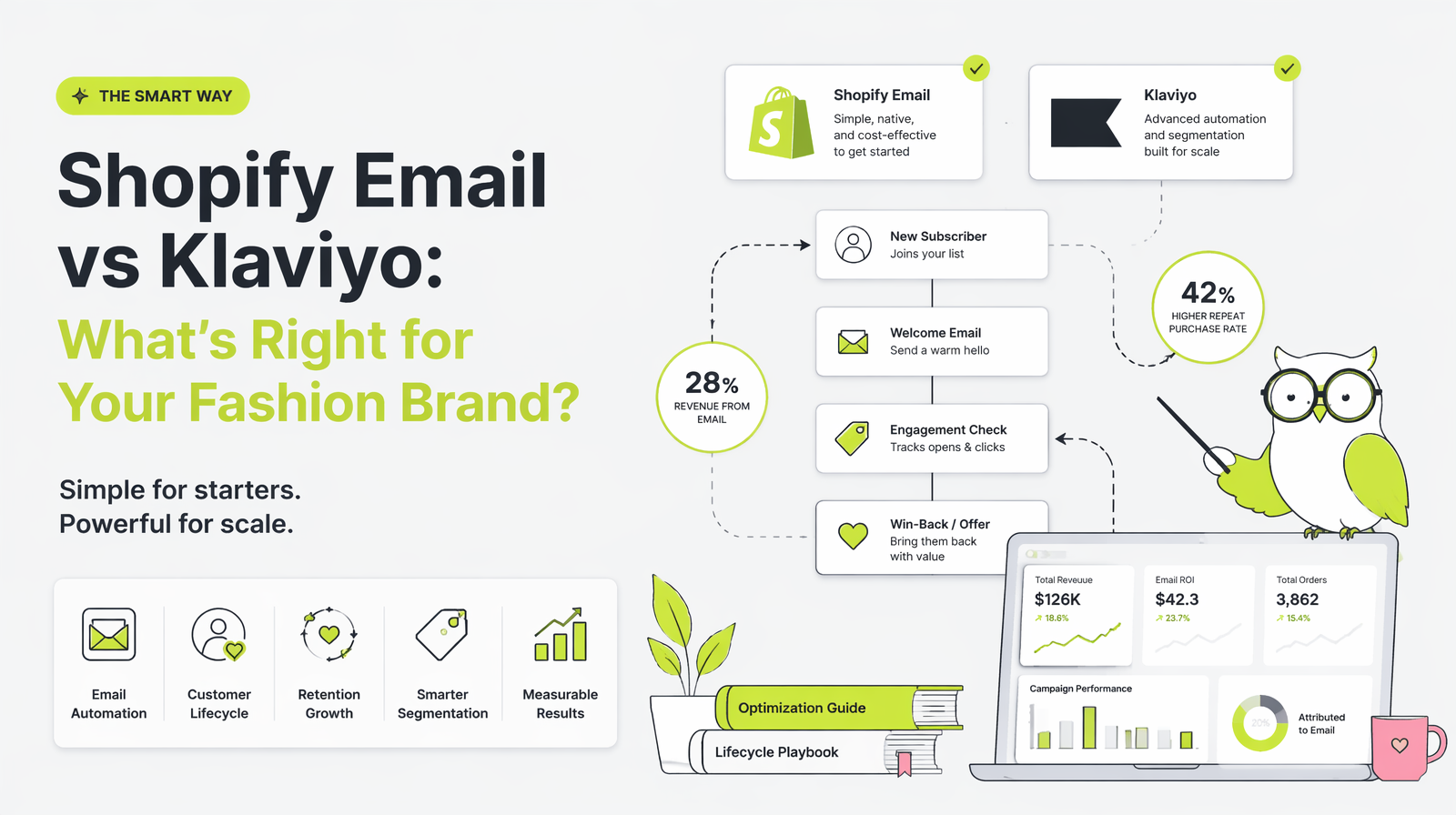
In this fashion-focused comparison, we will break down where each platform wins, where each one falls short, and how to choose the best email platform for clothing brands based on your real merchandising and retention needs.
Why fashion brands need a different email platform comparison
A beauty brand and a fashion brand do not email in the same way.
Fashion stores typically deal with:
- frequent new arrivals and seasonal launches
- highly visual merchandising
- multiple categories, collections, styles, and sizes
- faster inventory turnover
- price sensitivity around sales and markdowns
- shoppers who browse deeply before buying
That means klaviyo vs shopify email fashion decisions should be based on behavior complexity, not just feature tables.
For example, a clothing brand may need to:
- send a launch email only to shoppers who bought dresses in the past 90 days
- trigger browse abandonment for outerwear, but not accessories
- alert subscribers when a sold-out size returns
- push price-drop updates on wishlisted or viewed items
- separate VIP buyers from one-time discount shoppers
- coordinate email with push and SMS during a campaign week
If your campaigns are mostly newsletters and basic promotional sends, Shopify Email can cover a surprising amount. Shopify also supports segmentation and marketing automations natively within its ecosystem. Shopify Segmentation, Shopify Automations
But when your revenue depends on nuanced segments, dynamic lifecycle journeys, and high-volume apparel merchandising workflows, Klaviyo’s depth becomes more relevant.
Shopify Email for apparel brands: where it fits best
For smaller and earlier-stage stores, shopify email for apparel brands is appealing for one big reason: it removes friction.
It is already embedded in Shopify, the pricing is easy to understand, and merchants can start building campaigns without adding another major tool. Shopify gives merchants 10,000 free emails per month, with extra volume billed on a sliding scale that starts at $1 per 1,000 additional emails. Shopify notes that marketing automations count toward that limit, while abandoned checkout automations are always free. Shopify Help, Shopify Help
That pricing model is attractive for fashion startups because send-heavy moments are common. Think:
- announcing a new capsule collection
- promoting end-of-season markdowns
- sending weekly newsletters with styling edits
- running Black Friday or holiday promotional pushes
Shopify Email strengths for fashion stores
1. Lower operational complexity
If your team is small, simpler often wins. Shopify Email is easier to launch, manage, and troubleshoot because it lives inside the same commerce environment as your products, customers, and orders.
2. Predictable economics for send-based brands
Many apparel stores send frequently but do not necessarily need hyper-advanced segmentation. In that case, paying based primarily on sends can feel more manageable than paying for a large active-profile database.
3. Good fit for campaign-led retention
Fashion brands that rely on editorial newsletters, launch announcements, sale broadcasts, and welcome series can get solid value from Shopify Email before graduating to a more complex setup.
4. Native connection to Shopify data
You do not need to do much extra work to pull in products, discounts, or store data. That is especially helpful when merchandising speed matters.
If you are still choosing your stack, 10 Best Email Marketing Apps for Shopify Stores is a useful broader comparison, and Simple Shopify Email Tools: 8 Easiest Picks for Small Stores is relevant if ease of use is your top priority.
Where Shopify Email can feel limiting for fashion
Shopify Email tends to feel tightest when a fashion brand moves from “sending emails” to “running a retention system.”
That usually happens when you need:
- more layered customer segmentation
- more nuanced flows by category or product behavior
- more advanced lifecycle branching
- a broader omnichannel strategy tied to launches and promotions
For example, a fast-growing apparel brand may want separate nurture streams for denim shoppers, occasionwear buyers, and lapsed VIPs. It may also want stronger category-level browse abandonment logic. That is where Shopify Email can start to feel more basic than strategic.
If your store is already building more advanced audience logic, this guide to Shopify Customer Segmentation is worth reading.
Klaviyo for fashion ecommerce: where it fits best
Klaviyo is often the default upgrade path when a fashion store outgrows the basics.
That is because klaviyo for fashion ecommerce is strongest when customer behavior is rich, catalog depth is higher, and email performance depends on advanced targeting. Klaviyo also emphasizes benchmarking and segmentation as core levers for performance improvement. Its 2026 benchmark materials say the dataset includes more than 183,000 customers across industries including fashion.
Klaviyo strengths for apparel brands
1. Stronger segmentation depth
This matters a lot for fashion. You can build audiences around viewed categories, purchase recency, discount usage, order count, product affinity, geography, and more.
2. Better fit for behavioral automation
If your flows are central to revenue, Klaviyo is typically stronger. This includes post-purchase journeys, replenishment-inspired logic for consumable accessories, win-back flows, and more tailored browse and cart recovery.
3. More useful for large catalogs and varied merchandising
The more SKUs, collections, launches, and repeat campaigns you run, the more value you can get from a system built for intricate targeting.
4. Benchmarking and optimization depth
Fashion marketers often want to know whether a campaign or flow is actually underperforming relative to peers. Klaviyo’s benchmark tooling supports that comparison.
Where Klaviyo can hurt fashion brands
The main drawback is cost sprawl.
Klaviyo’s pricing is not just about how many emails you send. Billing depends on active profiles and usage, and plan changes can occur as your list or sending needs grow. Klaviyo’s own help documentation explains that billing is monthly and tied to products such as Profiles and Emails. Its free plan is limited to 250 profiles and 500 emails per month.
For fashion brands, that matters because list growth is not always clean. Popups, giveaway leads, seasonal acquisition spikes, and broad campaign collection can inflate active profiles quickly. In practice, some apparel brands pay for segmentation power they are not yet using well.
That does not make Klaviyo a bad choice. It just means it is best when your team is ready to operationalize that extra power.
Shopify Email vs Klaviyo for fashion brands: side-by-side by real use case
Here is the practical comparison that matters most.
1. New collection launches
If you are sending a simple launch blast to your full list or a few broad segments, Shopify Email is usually enough.
If you want to tailor launch campaigns by past product affinity, spend tier, style category, or predicted interest, Klaviyo is usually stronger.
Winner:
- Simplicity: Shopify Email
- Precision targeting: Klaviyo
2. Back-in-stock and price-drop journeys
Fashion stores often need urgency-led journeys, especially around popular sizes and sale periods.
If your needs are basic, Shopify Email may work as part of a simpler retention system. But if back-in-stock and price-drop messaging is a major revenue lever, many fashion brands eventually want more orchestration across channels, not just email.
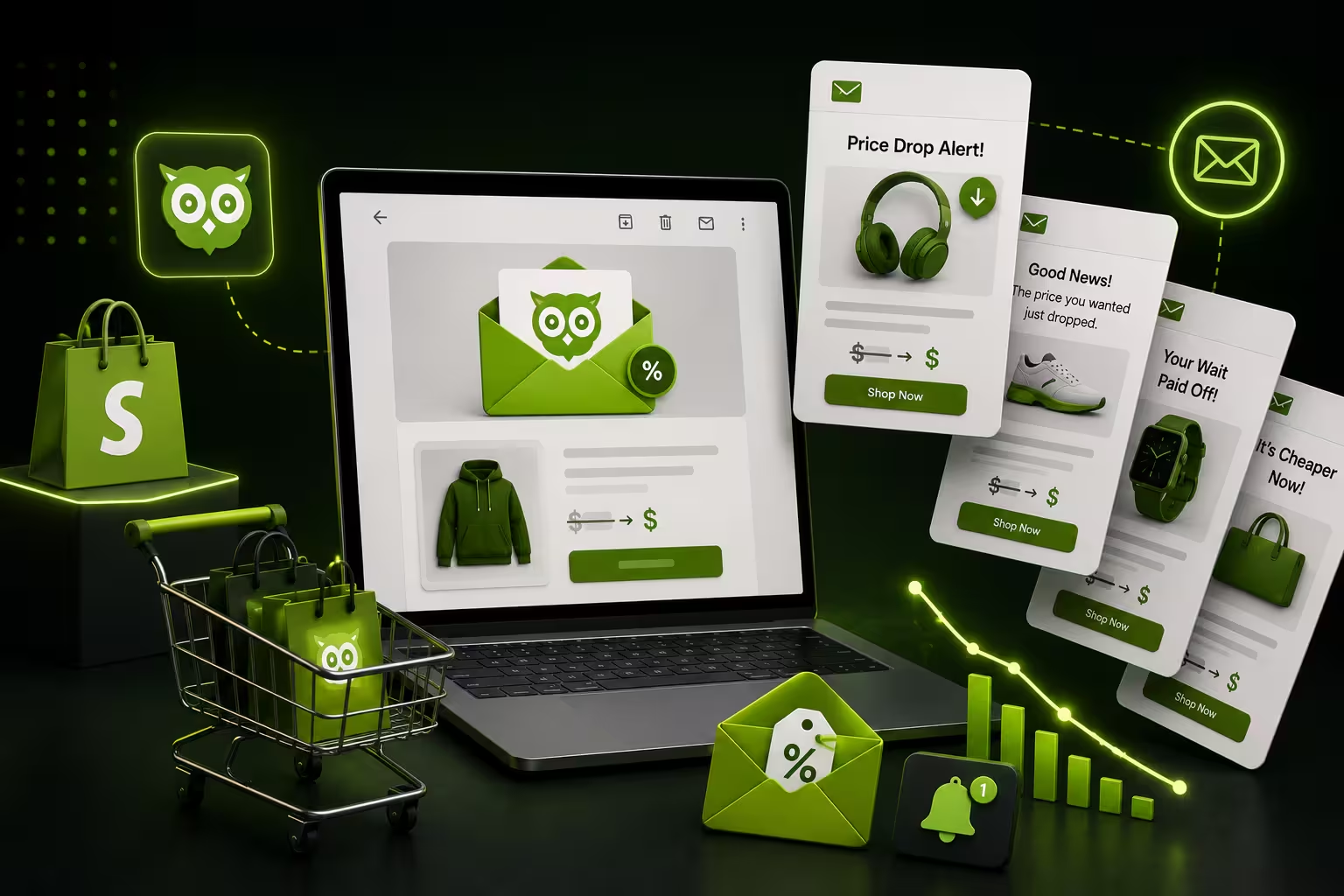
This is where PushOwl becomes especially relevant. Push notifications are naturally well suited for back-in-stock and price-drop alerts because they are immediate, click-friendly, and effective for time-sensitive shopping intent. See Turn Price Drops into Sales Instantly and Turn Browsers into Buyers with Push Notifications for Shopify🚀.
Winner:
- Email-only simple setup: Shopify Email or Klaviyo depending on complexity
- Urgency-driven multichannel alerts: PushOwl-led stack
3. Browse abandonment by category
This is a major fashion use case. A shopper who viewed five maxi dresses is different from one who browsed men’s sneakers.
If you want category-sensitive browse flows, Klaviyo generally has the edge because behavior-based segmentation is one of its strongest areas.
Winner: Klaviyo
4. Newsletter and merchandising sends
Weekly edits, lookbooks, trend roundups, and sale newsletters are staples for apparel brands.
If your main priority is sending polished campaigns fast without building a highly technical lifecycle program, Shopify Email performs well here. For inspiration on campaign structure, see 17+ Newsletter Formats That Top DTC Brands Actually Use and How To Write an Email Newsletter for Your Shopify Store in 2025.
Winner: Shopify Email
5. Omnichannel fashion retention
Fashion buying windows are short. Product demand changes fast. Restocks and markdowns are time-sensitive. That is why email alone is not always enough.
A drop announcement may work better with email plus push.
A flash sale may work better with SMS plus email.
A browse abandonment journey may recover more with push before email.
If your team is heading in that direction, exploring an omnichannel stack is smarter than making the entire decision about best email platform for clothing brands on email alone. Start with The Ultimate Shopify Omnichannel Marketing Strategy Guide, then compare options in Best Omnichannel Marketing Platforms for Shopify(Email + SMS + Push + Ads Compared).
Winner: PushOwl-style omnichannel setup
The true cost curve for fashion brands
This is where many comparisons stay too generic.
A fashion founder should ask two different questions:
- How much will I pay to send?
- How much will I pay to maintain my audience?
Shopify Email is usually easier on question one. The first 10,000 emails each month are free, and beyond that the pricing remains volume-based. That makes it attractive for early stores with small to mid-sized lists and regular campaigns. Shopify Help
Klaviyo becomes more justifiable when segmentation sophistication adds enough incremental revenue to offset profile-based cost. If your brand can generate meaningfully better results from tailored flows, then higher platform cost may still be efficient. Klaviyo’s own materials continue to emphasize segmentation and automation as key performance drivers. But plenty of fashion brands sit in the middle: too advanced for basic email alone, not ready for enterprise-style complexity, and looking for faster ROI across retention channels.
That middle is exactly where PushOwl can make more strategic sense. Instead of asking whether Shopify Email or Klaviyo wins in isolation, ask whether your growth actually depends on faster, more responsive omnichannel journeys. If yes, a platform built around Email, Push, & SMS may fit better than a pure email-first decision.
For budget-conscious merchants, Build an Omnichannel Shopify Stack for Under $200/month (Email + SMS + Push + Ads) is a helpful reference point.
Which platform should your fashion brand choose?
Here is the simplest decision framework.

Choose Shopify Email if:
- you are an early-stage or small apparel brand
- your campaigns are mostly newsletters, launches, and sale sends
- you want low setup complexity
- you want predictable, send-based pricing
- you do not yet need advanced branching and deep segmentation
Choose Klaviyo if:
- your catalog is larger and more segmented
- browse abandonment and lifecycle flows are major revenue drivers
- your team can actively manage advanced automation
- you need deeper behavioral segmentation
- higher platform cost is justified by higher retention sophistication
Choose PushOwl or an omnichannel path if:
- your fashion brand relies on launches, restocks, flash sales, and price drops
- you want faster response channels beyond email
- you are trying to improve retention without stitching together too many apps
- you want to coordinate email, push, and SMS in one strategy
If you are comparing stacks more broadly, PushOwl vs. Klaviyo offers a direct comparison, while Why PushOwl? explains the broader value proposition.
Conclusion
The best answer to shopify email vs klaviyo for fashion brands depends less on brand size alone and more on merchandising complexity.
If your fashion business is still in a “campaign-first” stage, Shopify Email is often the better fit. It is easier, cheaper to start, and tightly integrated with Shopify. For many apparel brands, that is enough to build a solid retention foundation.
If your business is already running advanced segmentation, category-level browse recovery, and deeper lifecycle logic, Klaviyo may be the stronger tool. Its value rises as your customer data strategy and automation maturity increase.
But if your real need is not just “better email” but better retention across launches, restocks, and urgency-driven moments, then the smartest move may be to stop treating email as the only decision. For modern fashion brands, an omnichannel setup can be the more profitable fit.
That is where PushOwl stands out: helping Shopify brands turn browsers into buyers with retention built for real ecommerce timing, not just more emails.