Price drop alert emails exist precisely for this moment when a customer has shown interest in a product but wasn't ready to buy at full price. These customers aren't comparing alternatives; they're simply hoping for a price reduction. When you see the price drop and email the customer, you have a golden opportunity to convert them into a sale. Many businesses fail to consider the individual behavior of each of their customers, instead sending the same type of email to all. This is incredibly expensive as customers begin to expect the discount. This guide will focus on the power of personalized price drop emails, offering twelve ways to send individual customer-interest emails, timing tricks, discount techniques and more to increase customer retention. If you have a Shopify store and want to put your product data to work and convert wish-listed products into sales, this guide is for you..
What is a Price Drop Alert email?
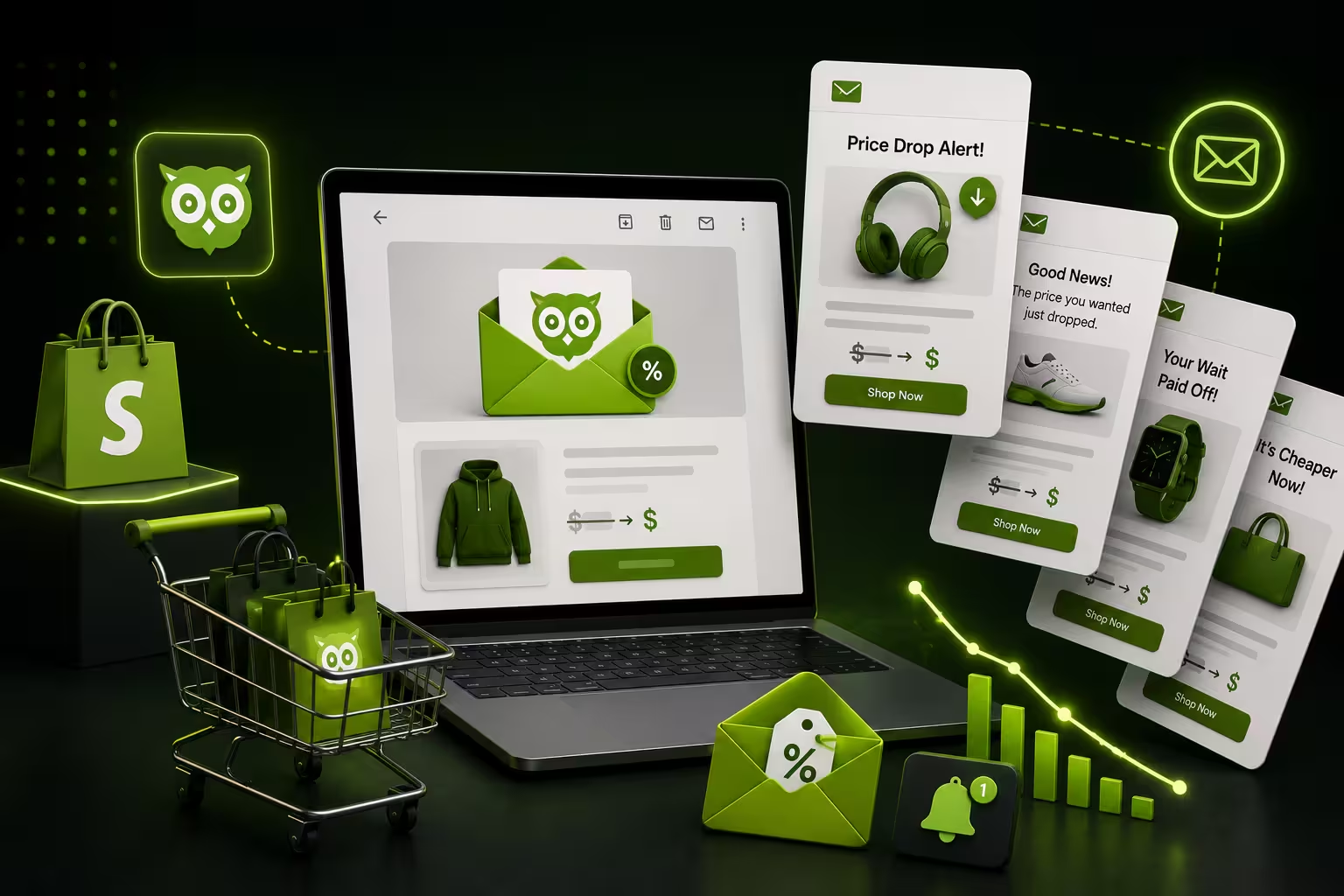
A price drop alert email is an automated email that is sent to a customer once a product that they have already engaged with-by wishlisting, viewing, adding to their cart or browsing-is subsequently price-dropped. When a product’s price field is updated it doesn’t matter when a marketing calendar says that there’s supposed to be an email blast-the trigger is actually based on a product's price change.
It’s more of a distinction than you might think. The promotional email goes to all of your customers because you decided to have a sale. The price drop alert goes to that one individual, and that one individual only, because that person expressed interest in that one product, and the product went on sale. That is why these emails are inherently different from a back in stock email (triggered by inventory levels), abandoned cart email (triggered by the session) or flash sale email (triggered by the calendar). It's the only email that leverages two of the strongest intent signals for an e-commerce purchase at the same time-direct product interest and a price reduction removing the primary barrier. That's why price drop alerts have an average open rate exceeding 40% and average click-through rates exceeding 12%, far and away from any promotional email campaign.
When Should You Send a Price Drop Alert Email?
Three different kinds of price drop triggers warrant an alert, and should not be handled the same. First is a permanent price change at the catalog level. The catalog price of a product has dropped permanently, and everyone who is engaged with it needs to know. The second is a temporary price change: a sale, flash event, holiday campaign that has a defined expiration date. Urgency copy is mandatory in this case it's how you convert. Third is a personalized offer at the segment level. A specific audience, like your wishlist subscribers, may receive an exclusive price reduction that isn't open to the general public. Each trigger requires a different kind of copy, a different sense of urgency, and a different channel stack.
Timing is critical. 60 minutes or less after the price has changed maximizes conversions. The further you are from the actual price reduction event, the more likely the customer has already come back to the site on their own, bought elsewhere, or lost the interest they initially had. Every hour of delay means revenue left on the table.
Frequency capping is paramount. Do not send more than one price drop alert per product per customer every 14 days. On a sale day with 50 items marked down simultaneously, you'll wind up with five automations per customer to the same subscriber in two hours. It isn't marketing; it's an unsubscribe or spam complaint at best. And one more best practice to build in from the beginning: don't send price drop alerts on new products within 30 days of launch. Customers learn that it pays to wait to purchase from launches, and this will do far more damage long term than it's worth in short term revenue recovery.
The Price Drop Intent Ladder: How to Segment Customers by Purchase Intent
Every customer doesn’t respond to price drop emails in the same way. Treating everyone equally by using similar subject lines, body copy, and discount rules will miss opportunities. The Price Drop Intent Ladder helps to segment customers by their intent so the message can be personalized.
Rung 1 - Wishlist Savers: These high-intent customers have put an item on a wishlist, suggesting that it’s something they intend to purchase but were only waiting for price or timing. These will have high conversion and can’t be tempted with greater offers. Don’t offer these customers anything beyond the price decrease.
Rung 2 - Cart Abandoners: These users exhibited high intent, adding something to their cart, but didn't make the purchase. It was likely the price, or potentially the shipping fees. These customers should be incentivized more than wish list savers, perhaps with reasonable extras such as free shipping.
Rung 3 - Browse Abandoners: These customers viewed a product page more than once in a 14 day period. They are interested in the product but don’t know that they are waiting for the price. Use higher intensity techniques here such as talking about stock levels or use timers. A strong offer could be a web push since they may not have shared their email address.
Rung 4 - General Subscribers: Customers who have purchased or are potential customers in this product category but have not interacted with this specific SKU. These have low intent and would require much steeper discounts in order to convert so inventory can be cleared. The phrase that has been around for a while is that “the wishlist saver is the cheapest customer to acquire” as they were already convinced and price was the only barrier to purchase.
Anatomy of a Price Drop Email That Converts
In addition to the elements that make any price drop email work, a high-converting price drop email includes the following. The subject line of your email should ideally contain the product name along with the price trigger such as "[Product] is now $X." Phrasing such as this works better than generic "price drop alert" subject lines because the consumer immediately knows, is it worth opening?
The preview text of your email should state the new dollar price or the percentage off first. "Save $30" will work better than "15% off" when marketing lower-priced products. Your email should include a simple product image with no background rather than lifestyle images. The reason is that the focus is supposed to be on the product and its new price. The email copy needs to include the following four things: crossed-out old price, new price, saving, and urgency trigger (either a time or stock trigger). Call to action button copy should say either "Buy at New Price" or "Shop [Product Name]" and no vague language like "Learn More." In this particular email, do not attempt to cross-sell the customer because you will want to attempt that in a follow-up if they don't purchase the first one.
12 Price Drop Alert Email Templates
Group A: Wishlist Saver Templates
Template 1-Standard Wishlist Drop Subject: {Product Name} just dropped to {New Price} Preview: You saved it. Now it's {Savings Amount} less. Body: Hey {First Name}, good news - {Product Name} on your wishlist just got a price update. It's now {New Price}, down from {Old Price}. Nothing else to wait for. Grab it before the price changes again. CTA: Buy at New Price When to send: Any catalog-level price reduction on a wishlisted item. Send immediately. Email only for this rung-no need to stack SMS.
Template 2 - Wishlist First Time Buyer DropSubject: Your {Product Name} has dropped-now’s your chance, {First Name}Preview:Saved it once; price just dropped. Body: Hey {First Name}, you’ve yet to order from us, but you did save {Product Name} to your wishlist earlier. Good news, its price has dropped to {New Price}. If that was the only thing stopping you from getting it, not anymore. First orders ship free. CTA: Shop My Wishlist When to send: subscriber has zero purchases and one (or more) wishlist save. Send it right away. Consider pairing with a web push at +30min.
Template 3 - Loyal Customer Wishlist Drop Subject: Hey {First Name}, your wishlisted {Product Name} just dropped Preview: Code not needed. The price already dropped for you. Body: {First Name}, you know when a product is meant for you. {Product Name} just dropped to {New Price}. No discount code, no complicated instructions, just a lower price available. Just for being here first. CTA: Shop the new price When to use: If you have a customer who is a repeat buyer with 3+ orders and has wishlisted an item. It should be sent instantly, no other discount code should be applied.
Template 4 - Saved Wishlist Drop Subject: Worth the wait – {Product Name} now at {New Price} Preview: You saved this {X} days ago, it's finally caught up. Body: Hey {First Name}, sometimes good things are worth waiting for. {Product Name} was saved a little while ago and it's just dropped to {New Price}. Not sure how long the price will last but you were definitely the first to hear about it. CTA: Shop Now When to use: Product saved more than 30 days ago, no purchase yet. Immediately send followed by +24hr push if no click.
Group B: Cart Abandoner Templates
Template 5 - Same Day Cart Drop Subject: Your {Product Name} in cart is now on sale! Preview: You dropped it. Then its price did too. Body: Hey {First Name}, You forgot your {Product Name} - it just dropped from {Old Price} to {New Price}. It's still saved. One click and it's all yours. CTA: Complete My Order When: Cart abandoned less than 24 hrs ago, with the price dropping in the window, within an hour of the drop. Consider accompanying by an SMS for above-AOV abandoned cart visitors.
Template 6 - cart return, price drops Subject: {Product Name} is still in your cart and has gotten cheaper! Preview: was {Old Price} now {New Price}. Your cart is waiting... Body: Hi {First Name}, we've noticed {Product Name} sitting in your cart for a few days now, and the great news is it is still there! Better yet, its price has been reduced to just {New Price}. Don't delay as stock levels are not the only thing that could run out soon! CTA: Return to Cart When to send: Cart abandoned for 7+ days, no return visit, within 60 minutes of price drop. Pair with web push at +2 hrs.
Template 7 - High AOV Cart Drop Subject: {Product Name} dropped + we're shipping for free Preview: {New Price} + free shipping. It's time to checkout. Body: {First Name}, it looks like you were checking out {Product Name} which is now {New Price}. Orders of this size now qualify for free expedited shipping, automatically at checkout. No coupon code or strings attached – just free express shipping. Buy it at {New Price}-shipping free
Group C: Browse Abandoner Templates
Template 8 - Multi-View Browse Drop Subject: You've looked at {Product Name} a few times - it just dropped Preview: Now at {New Price}. Might be the sign you were waiting for. Body: Hi {First Name}, we noticed you've come back to look at {Product Name} more than once. It just dropped to {New Price} - a {Savings Amount} saving. If you've been deciding, this might be the moment. Only {Stock Count} left at this price. CTA: Shop Now at {New Price} Use cases: Shopper has viewed the product page 3+ times in the last 14 days. Use with a timed web push; browse abandoners who haven't submitted email need to be reached through push.
Template 9 - Comparison-Shopper DropSubject: Before you decide - {Product Name} just got a lot more competitive Preview: {New Price}. Plus {key differentiator}.Body: Hi {First Name}, we know you're doing your research - that's smart. {Product Name} just dropped to {New Price}. Beyond price: {one sentence on materials, reviews, or guarantee}. We think you'll be glad you waited.CTA: See the Full DetailsWhen to use: Shopper has browsed this product and a competitor category within the same session. Lead with your differentiator, not just the price. Send immediately.
Group D: Broadcast & Inventory Templates
Template 10 - Category-wide price dropSubject: Prices just dropped across {Category} - here's what to knowPreview: {Product 1}, {Product 2}, and {Product 3}-all lower.Body: Hi {First Name}, we just reduced prices across {Category}. Here are three worth knowing about: {Product 1}-now {Price 1}. {Product 2}-now {Price 2}. {Product 3}-now {Price 3}. Shop the full selection below.CTA: See All Reduced Prices When to use: When multiple SKUs go on sale at once. Segment by prior category purchase history before sending widely. Use web push for non-logged-in visitors.
Template 11-End-of-Season Clearance Topic: Last Price Reduction on [Product Name]-[New Price] Preview: This price won't ever come back, and neither will the stock. Body: Hi [First Name], we're clearing space for the next collection, which means that [Product Name] is on its last price reduction and available for just [New Price]. What's here today is gone forever! This is the absolute lowest you'll see this item available for. CTA: Grab Before It's Gone Best time to send: End-of-season sale/inventory clear-out. The main driver for urgency is scarcity. Web pushes & texts to top-intent segments will yield the highest results.
Template 12 - VIP Early Access Drop Subject: {First Name}, early access to {Product Name} drop tomorrow. Today's pricing. First peek. 24 hours ahead of public. Body: Hey {First Name}, we wanted to give you a heads-up that as a VIP you're one of the first people on earth to see tomorrow's drop on {Product Name}. Starting now, this can be yours for {New Price} --24 hours before anyone can even so much as browse it. No coupon necessary. Just use your account. CTA: shop my early access Timing: Use for an upcoming markdown or pre-sale event. VIP segment can be those who have made a certain amount of purchase/high lifetime value. Encourages loyalty and urgency simultaneously, without using a stacked offer.
Mistakes on common price drop emails
First is sending to customers who purchased the exact same product for the full price earlier. The quickest way to kill the trust of a customer is to inform him that the product that he just purchased for full price is now available at a lower price. Before you do anything else, ensure that your automation rule has a 60-day post purchase exclusion period. Second mistake: Not including the product name in the subject line of the email. "Price drop alert" is not a compelling reason to open the email. The subject line is only effective with the product name included in it – that is the only identifier which makes the email feel like a personalized communication to the shopper, rather than marketing spam.
Third mistake: indiscriminately stacking discounts. Wishlist savers do not need an additional 10% added to an already reduced price. Giving them this extra incentive trains them to expect stacked discounts on all their future wishlist items – an expectation which will erode your margin on all categories over time. Stacked incentives are reserved for Rung 3 & Rung 4 where intent is lower, and the offer must work harder. Fourth mistake: not leveraging complementary channels like web push and SMS. Email alone only captures around half of all recoverable intent on price drops. Abandoned browse users for instance, may be unknown, and can only be targeted via push notifications. Only sending via email implies that a huge portion of your recoverable audience is not being targeted.
Fifth mistake: Triggering on minuscule price fluctuations. A 3% drop in the price of a $50 product is not sufficient to encourage anyone to open the email – rather, it is a trigger for unsubscribe. Implement a 10-15% price drop delta before the automation fires. Any drop lower than that simply contributes to noise, and excessive noise kills list engagement. Sixth mistake: failing to implement a time or stock-based urgency mechanism for the price drop email. If a price drop is sent to a customer without a deadline, he naturally concludes that the discount is permanent, giving him all the time in the world to make the purchase later.
Should You Layer Price Drop Alert Emails with SMS and Web Push Notifications?
Yes, but not for everyone. Stack your channels based on Intent Ladder not your own biases. For Wishlist savers (Rung 1) use email for the primary channel as these are users who expect to be communicated with andSMS forVIPwishlist savers - high value users expected to convert. Use an email for Cart abandoners (Rung 2) for the context, and SMS for timeliness - an SMS should be sent within 30 minutes of a price change. For browse abandoners (Rung 3) use web push as you will not have their emails-allowing you to alert anonymous users about price drops after they’ve visited a few times. Identified browse abandoners will be using web push and email.
To the general broadcast segment (Rung 4), you can use email + web push to target your identified and anonymous users, respectively. SMS broadcasts to the general broadcast segment are generally not worthwhile for the expense; use SMS spend for Rungs 1 and 2, which have higher probabilities for conversion. In general: your segment definition, and accordingly your channel selection, should reflect what behavior reveals about a segment's intent, not default to whatever is simplest to implement.
How PushOwl automatically sends price drop notifications via email, push, and SMS
PushOwl natively monitors your Shopify product price field-no need for Manual Lists uploads, CS V exports, or Zapier connections. Once the price drops more than the delta you've set (e.g. 10% or higher) the automation triggers automatically via the channels that the subscriber has opted into: A shopper who saves a product to a wishlist and has opted into emails gets an email; a browser abandoner who opted into web push gets a push notification; a VIP cart abandoner who has also opted into SMS gets an email, a push and an SMS in the order, at the time that you desire.
PushOwl's pre-built price drop templates are structured according to the Intent Ladder – you have different flows separated by your Wishlist, Cart Abandonment and Browse Abandonment segments, each with slightly different default messaging and timed windows. Exclude post-purchases automatically by setting a 60-day window and the automation will skip those who have recently purchased the item. Price drops also prevent a single subscriber from receiving multiple notifications of a price drop for one product for a given time window, even if the item is on sale for an entire day. The attribution dashboard will highlight exactly how much revenue each price drop flow recovered and via which channel so you know which one is performing best and how to adjust.
As well as re-engagement automations via email for your store, price drops flow naturally into your wider lifecycle, if a shopper doesn’t convert via price drop, it's easy for the shopper to go through to your win-back flows if they have gone inactive and create an efficient flow across your store, rather than having the automation end there and be seen as an isolated event.
Conclusion: Start Sending Smarter Price Drop Alert Emails Today
Price drops send converting due to a fundamental congruence between what a shopper declared interest in and how they just received a price moving in their favor. The companies doing this well don’t use better copy than anyone else, they leverage segmentation by intent, align their discounting logic with what individual segments truly desire, and ensure their channels are layered such that your message hits where shoppers are most likely to convert. This guide's 12 templates are your copy; The Intent Ladder is your logic. Together they automate success.
Ready to automate your price drop alerts across email, push, and SMS? PushOwl makes it easy to set up intent-based price drop notifications that convert without the manual work. Start free and see the difference a segmented, channel-layered approach makes to your Shopify store revenue.