When to Use SMS vs Push vs Email on Shopify: A Practical Guide for Merchants

Shopify
Pushowl Marketing Team
March 3, 2026
Content

The Wrong Channel at the Right Moment Still Loses

Sending a flash sale announcement by email at 9 a.m. on a Tuesday is not a strategy. By the time most subscribers open it, the sale is halfway over. Sending that same message by SMS means 90% of recipients have read it within three minutes.

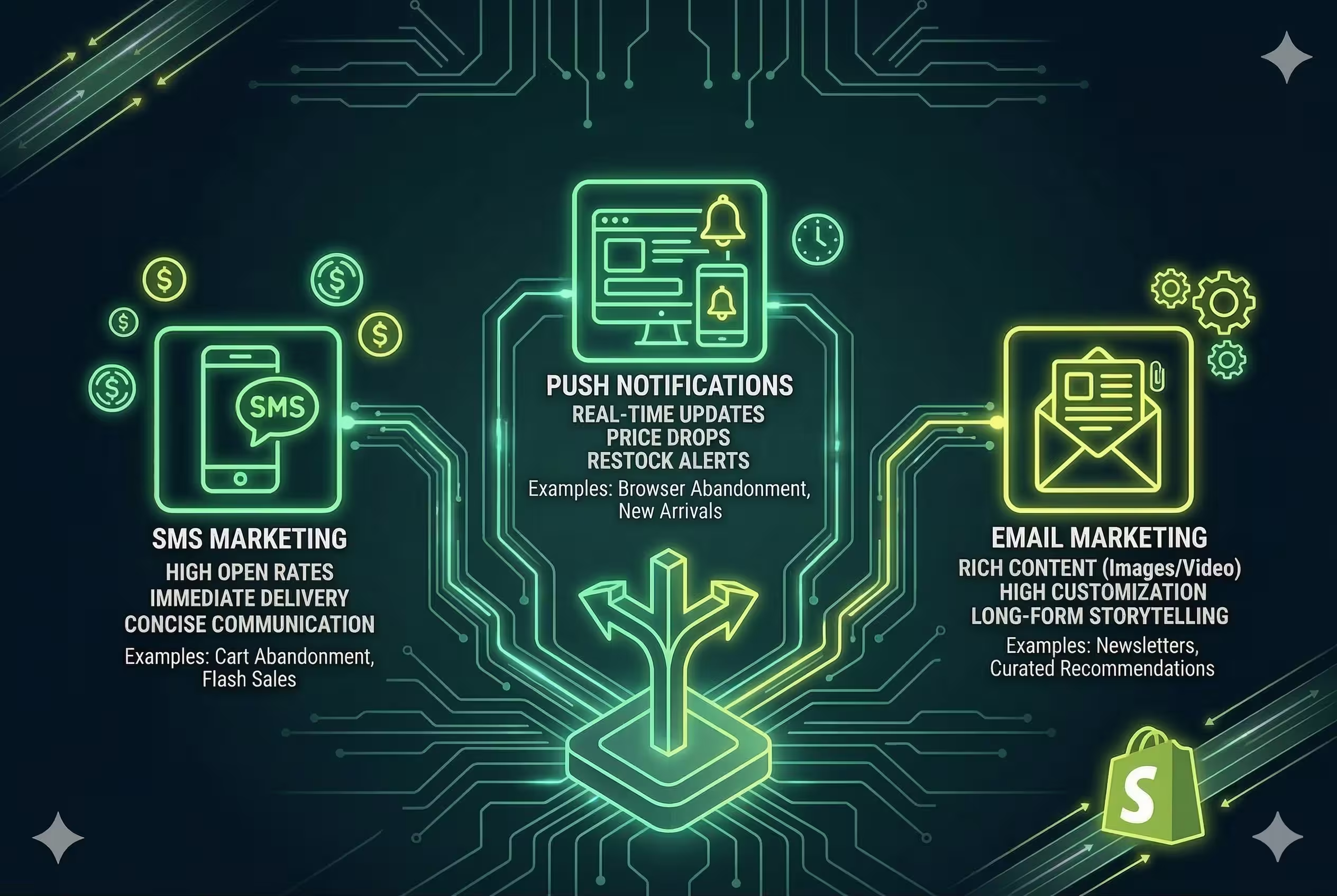
The inverse is also true. An SMS about your weekly blog post will feel intrusive and off-brand. Email is the right format for content, newsletters, and anything that benefits from imagery and length. Push notifications sit between the two: immediate enough for price drops and back-in-stock alerts, low-friction enough to use without burning subscriber trust.

Most Shopify merchants do not have a messaging problem. They have a channel-matching problem. The same message lands completely differently depending on the surface it arrives on, and the wrong pairing is often the reason a campaign underperforms.

If you are still building your channel mix, the Shopify omnichannel marketing strategy guide covers the architecture that makes multi-channel sequencing work before you start optimizing individual channel timing.

This guide is the next layer: a practical framework for knowing which channel to reach for at each specific moment in the customer journey.

What Each Channel Is Actually Good At

Before the decision rules, here is an honest account of each channel's strengths and natural limits.

Email

Typical open rate: 20% to 35% (industry average for ecommerce)

Best for: Storytelling, product education, order and shipping information, weekly newsletters, VIP loyalty communications, review requests, long-form nurture sequences

Avoid for: Time-critical urgency plays, situations where a 24-hour delivery window materially changes the outcome

Setup note: Email requires the most build time per message but offers the highest content ceiling. It is the only channel appropriate for editorial content, multi-product showcases, and messages that require reading rather than a glance.

SMS

Typical open rate: 90%+ open rate; most messages read within 3 minutes

Best for: Flash sales with short windows, abandoned cart recovery within the first hour, shipping confirmations, win-back offers for lapsed customers, exclusive loyalty rewards

Avoid for: Content marketing, newsletters, any message requiring more than 160 characters to be coherent without a link, anything that would feel intrusive from an unknown sender

Setup note: SMS has the highest compliance overhead of the three channels. TCPA and GDPR opt-in requirements are non-negotiable. See the SMS consent guide before collecting a single phone number.

Web Push

Typical open rate: 50% to 70% delivery; click-through rates typically 1% to 5%

Best for: Browse abandonment recovery, back-in-stock and price drop alerts, flash sale announcements, re-engagement for customers who have gone quiet on email and SMS

Avoid for: Long-form content, anything requiring context or explanation, messages that depend on the recipient knowing your brand (push works best as a reinforcement channel, not a primary introduction)

Setup note: Web push is the lowest-friction channel to build an audience for. A single browser click is the only opt-in required: no email address, no phone number. This makes it uniquely valuable for reaching site visitors before they have converted into email or SMS subscribers.

For a deeper read on what is possible with web push beyond basic alerts, see types of web push notification campaigns and web push notification examples.

The Channel Decision Matrix: 12 Customer Moments Mapped

The table below maps the most common Shopify customer moments to the best channel for each, the strongest alternative, what to avoid, and the reasoning behind the recommendation.

Customer Moment Best Channel Second Choice Avoid Why
Cart abandoned (<1 hr) SMS Push Email Urgency window is short; SMS is read in minutes
Cart abandoned (1-24 hr) Email SMS Push Email allows richer content, product imagery, offer details
Browse abandonment Push Email SMS Low-intent signal; push is low-friction with no opt-in cost
Welcome / first opt-in Email Push SMS Email sets brand expectations; SMS feels intrusive early
Flash sale (4-8 hr window) SMS Push Email 90%+ open rate in minutes; email is too slow for urgency
Back-in-stock alert Push Email SMS Push is immediate; email works if push list is small
Post-purchase (day 1-3) Email Push SMS Email handles order info, cross-sell, and review requests
Win-back (60-90 day lapse) SMS Email Push SMS exclusivity creates urgency email cannot replicate
VIP or loyalty milestone Email SMS Push Email handles long-form storytelling and reward details
Price drop on wishlist item Push SMS Email Push is real-time and non-intrusive for price signals
Shipping update SMS Email Push SMS read rate ensures operational messages are seen
Weekly newsletter / content Email None SMS Email is the only appropriate channel for editorial content

A few patterns worth noting across the matrix. SMS wins on urgency. Email wins on depth. Push wins on low-intent and low-friction moments where you want to reach someone without demanding their attention. The worst channel choice is almost always email for time-critical offers and SMS for content-heavy messages.

Four High-Revenue Moments Explained in Detail

1. Abandoned Cart: The Most Mishandled Sequence in Ecommerce

Cart abandonment affects 65% to 75% of all carts across Shopify stores. The channel sequencing of your recovery flow determines how much of that revenue you recover.

The hour immediately after abandonment is the highest-intent window. A customer who built a cart and walked away is still close to a buying decision. SMS is the right channel here because it is read in minutes, not hours. A single message with a direct link back to the cart, ideally referencing the specific product, will consistently outperform an email at the same moment.

Hours two through twenty-four are where email earns its place. The longer format allows you to show the product, address objections, include reviews, and optionally offer a discount. By this point, the raw urgency has passed and context becomes more valuable than immediacy.

If the customer still has not returned by day two, a push notification on their next site visit (if they have opted in) acts as a low-friction reminder without the commitment of another SMS or email. See abandoned cart email examples and abandoned cart reminders best practices for the full sequence structure.

2. Browse Abandonment: The Low-Intent Signal Most Stores Ignore

Browse abandonment is a weaker signal than cart abandonment. A visitor viewed a product but did not add it to cart. They may be researching, comparing prices, or genuinely not ready. The channel choice needs to reflect that lower intent.

Push notifications are the right tool here precisely because they are low-commitment on both sides. The merchant sends a short, non-pressuring message. The customer can dismiss it with a swipe if the timing is wrong. An SMS for a browse abandon feels intrusive because the contact intensity does not match the signal strength. See browse abandonment notification strategies for copy frameworks and timing guidance.

3. Flash Sales: Why Email Almost Always Underperforms

Email open rates for ecommerce average 20% to 35% over the course of a day. That means if you send a flash sale email for a 6-hour window at 10 a.m., a significant portion of your list will not see it until the sale is over or in its final hour. See email open rates 2026 for the current benchmarks by category.

SMS solves this structurally. A flash sale SMS sent at 10 a.m. reaches 90% of subscribers within three minutes. The message needs to be short: the offer, the end time, and the link. Nothing else. Web push is the second-best option for flash sales because of its real-time delivery and the non-intrusive format that still appears on-screen immediately.

Email works for flash sales when combined with SMS, not as the primary channel. Send the SMS to trigger action, follow with an email two hours before the deadline to capture those who missed the SMS. For email send timing guidance, see best time to send an email newsletter.

4. Win-Back Campaigns: The Case for SMS Exclusivity

For customers who have not purchased in 60 to 90 days, the challenge is standing out in channels they have started ignoring. If your email open rate from lapsed customers is 8%, sending another email with a discount is unlikely to move the needle.

SMS win-back offers perform better for a specific reason: they feel exclusive. A customer who has been quiet on email receiving an SMS with an offer that references the channel directly, something like "we saved this for our SMS subscribers only," perceives the offer differently than another email in a crowded inbox. See win-back campaign examples for the messaging structures that consistently outperform single-channel re-engagement.

Channel-by-Channel Message Examples for Key Moments

The examples below are templates, not copy to use verbatim. Replace [Brand], [Product], and offer details with your own. The structure is what matters.

Abandoned Cart (triggered 45 minutes after abandonment)

Email: Subject: You left something behindYour [Product] is waiting. We held your cart, but it will not last forever. [Link to cart] If you have questions about sizing, materials, or shipping, reply to this email.

SMS [Brand]: Your cart is still open. Grab your [Product] before it sells out: [Short link] Reply STOP to opt out.

Push [Brand]: Still thinking about [Product]? Your cart is saved. [Short link]

Flash Sale (4-hour window)

Email: Subject: 4 hours only: 25% off everythingToday, 10 a.m. to 2 p.m. only. Use code FLASH25 at checkout. Shop now: [Link] This offer expires at 2 p.m. and will not be extended.

SMS [Brand]: 25% off for 4 hours only. Ends at 2pm. No code needed: [Short link] Reply STOP to opt out.

Push [Brand]: Flash sale live now. 25% off, 4 hours only. Shop: [Short link]

Back in Stock

Email: Subject: [Product] is backGood news: [Product] in [size/color] is back in stock. These sell fast, so we wanted to let you know first. [Link]

SMS [Brand]: [Product] is back in stock. Grab yours: [Short link] Reply STOP to opt out.

Push [Brand]: [Product] is back. Limited stock: [Short link]

Frequency Guardrails: How Often Is Too Often

Channel fatigue is a real cost. Customers who opt out because of over-sending cannot be re-opted in without their active consent, and in the case of SMS, opt-out rates above 2% will trigger deliverability reviews from carriers.

Channel Recommended Frequency Warning Signs Reset Threshold
Email 2-4x per month for campaigns; automated flows as triggered Open rate drops below 15%; unsubscribe rate above 0.5%/send Segment non-openers at 90 days; suppress or re-permission
SMS 2-6x per month maximum; automated flows as triggered Opt-out rate above 2%; any spam complaints Back off to 2x/month; audit content before scaling
Web Push Up to daily for triggered; 2-3x per week for campaigns Click rate drops below 1%; high dismiss rate Reduce to 3x/week; review message relevance and timing

For the detailed mechanics of push notification frequency and its effect on engagement, see web push notification frequency guide. For email-specific send frequency and its effect on deliverability, see email blasts without spamming on Shopify.

Channel Choice Changes by Segment, Not Just by Moment

The decision matrix above applies to your general subscriber base. It shifts when you apply segmentation.

A VIP customer who has purchased four times in six months can receive SMS communications at a higher frequency without the same opt-out risk as a one-time buyer. A customer who has never opened an email should be deprioritized in email campaigns and prioritized in push. A subscriber who opted in via SMS but never via email should receive your flash sale offers through SMS, not a channel they have not chosen. This is the operational value of customer segmentation on Shopify: the right channel for the right customer is not always the same as the right channel for the right moment.

The lifecycle layer matters too. A customer in their first 30 days post-purchase needs different channel treatment than a customer who has gone 90 days without an order. See lifecycle segmentation for Shopify for the framework that maps customer stage to channel strategy.

Which Channel to Launch First if You Are Starting from Zero

The practical answer depends on your current subscriber base. If you have an email list already built, that is your starting point. Activate a basic abandoned cart email flow, then layer in push notifications as your second channel. Push requires no subscriber data to start building, and you can be reaching opted-in visitors from day one.

SMS should typically be the third channel you activate, after email and push. Not because it is less effective, but because it has the highest compliance overhead and works best when your brand already has an established relationship with the customer. Sending SMS to someone who has only heard from you once before is likely to drive opt-outs rather than conversions.

For building the email list that anchors the full channel stack, see how to build an email list for Shopify. For the SMS compliance foundations, see the SMS consent guide for Shopify brands. For email automation that connects all three channels into a coherent flow, see email marketing automation for ecommerce.

PushOwl is worth naming specifically here for one structural reason: it is the only channel on this list where your subscriber base can grow before your email or SMS list exists. A visitor who comes to your store, gets a browser prompt, and clicks allow is now reachable. No form fill. No checkout required. That zero-friction opt-in path means stores using web push consistently build a reachable audience faster than those relying on email or SMS alone in the early stages.

Frequently Asked Questions

  • Should I use SMS or email for abandoned cart recovery on Shopify?

    Plus IconSubtract Icon

    Use both, but in sequence. SMS within the first 45 to 60 minutes, email between hours two and twenty-four. The first window belongs to SMS because of its near-instant open rate. After that, email allows you to show the product, address objections, and optionally include an offer with more context than SMS allows. Stores running both channels in a coordinated sequence consistently see higher combined recovery rates than those running either channel alone.

  • What is the difference between SMS and push notifications for Shopify?

    Plus IconSubtract Icon

    SMS is delivered to a phone number and requires explicit opt-in consent under TCPA and GDPR. It has a 90%+ open rate and is best for high-urgency, high-intent moments. Push notifications are delivered through the browser and require only a single browser click to opt in, with no personal data collected. Push has a lower open rate than SMS but a much lower friction opt-in process, making it better for reaching early-stage visitors before they have provided contact details. SMS is more personal and commands more attention; push is more scalable and lower risk to deploy early.

  • How often should I send SMS, push, and email to Shopify customers?

    Plus IconSubtract Icon

    As a starting point: email two to four times per month for campaigns, with automated flows running on triggers. SMS two to six times per month maximum for campaigns; automated flows (cart recovery, shipping updates) run as triggered without counting toward the campaign limit. Push notifications up to daily for triggered automations, two to three times per week for campaign broadcasts. Watch your opt-out rate on SMS (flag anything above 2%) and your unsubscribe rate on email (anything above 0.5% per send indicates a frequency or relevance issue).

  • Can web push notifications replace email for Shopify stores?

    Plus IconSubtract Icon

    No. Push notifications are excellent for time-sensitive, low-context messages and for reaching customers who have opted in but not yet provided an email address. Email remains the only appropriate channel for editorial content, order information, review requests, and messages that benefit from length, imagery, and formatting. The two channels are complementary rather than substitutes. The right framing is that push handles moments email is too slow for, and email handles depth that push cannot carry.

  • When should I use web push instead of SMS on Shopify?

    Plus IconSubtract Icon

    Use push instead of SMS when the moment is low-intent (browse abandonment, price drop alerts, back-in-stock notifications) and when the customer has not yet provided a phone number. Push is also preferable for high-frequency use cases like daily flash sales, since it carries a lower opt-out risk than SMS at the same frequency. SMS earns its place when urgency is high, the customer relationship is established, and the message requires a response or action within a short time window.

  • What is the best channel for a Shopify flash sale?

    Plus IconSubtract Icon

    SMS first, push second, email third. A flash sale with a four to eight hour window needs a channel that delivers and gets read within minutes, not hours. SMS reaches 90% of subscribers within three minutes of delivery. Push notifications land on-screen immediately and are effective for customers who have opted in but not provided a phone number. Email is the weakest primary channel for time-critical offers but works well as a secondary message sent two hours before the deadline to capture those who missed the first two.

  • How do I decide which channels to build first for a new Shopify store?

    Plus IconSubtract Icon

    Start with email because it requires no additional compliance overhead beyond basic GDPR or CAN-SPAM compliance and allows for the richest content per message. Add push notifications as the second channel because the opt-in process is the lowest-friction of all three and you can start building an audience from day one of your store going live. Activate SMS third, after the customer relationship has been established through at least one prior interaction. See the email marketing campaigns guide for Shopify for the campaign architecture to build on top of this channel sequence.

Access your 9000 free newsletters with Brevo
access newsletters