If you run a Shopify store, you’ve seen customers browse products, add them to their basket, and leave without making any purchases. With 70-80% of carts paying, abandoning in between is not just a drop-off; this makes a huge revenue hole in your funnel. Email has been the primary channel (which is declining in response rates) but suffers average open rates below 20%, with many more emails coming into inboxes to minimize their visibility.
And that’s where abandoned cart SMS Shopify strategies enter the stage: With an open rate of 98%, most SMS messages are read right after they’ve been sent, making it one of the fastest and most effective ways to get those shoppers back at checkout. Brands using structured abandoned cart SMS Shopify templates, smart timing, segmentation, and distinct calls to action, see consistent recovery rates of 5–15% that surpass email.
That doesn’t mean that sending random reminders is the ticket to success. A generic text sent to everyone will do more harm than good. Well-designed systems are what get results: the right message to the right customer at the right time. This guide dives into timing frameworks that dictate proven cart recovery performance, high-converting abandoned cart SMS Shopify templates, segmentation strategies, and testing methodology to help you get your cart recovery back on track.
The Benchmark Numbers You Need to Know First
Before you create your SMS cart recovery templates, it’s important that you know what good performance looks like. Without clear benchmarks, it’s easy to be content that your sequence is working when, in fact, it may be leaving money on the table.
Most merchants get back a few carts and quote the end of optimizations, leaving up to 60% closing revenue on the table.
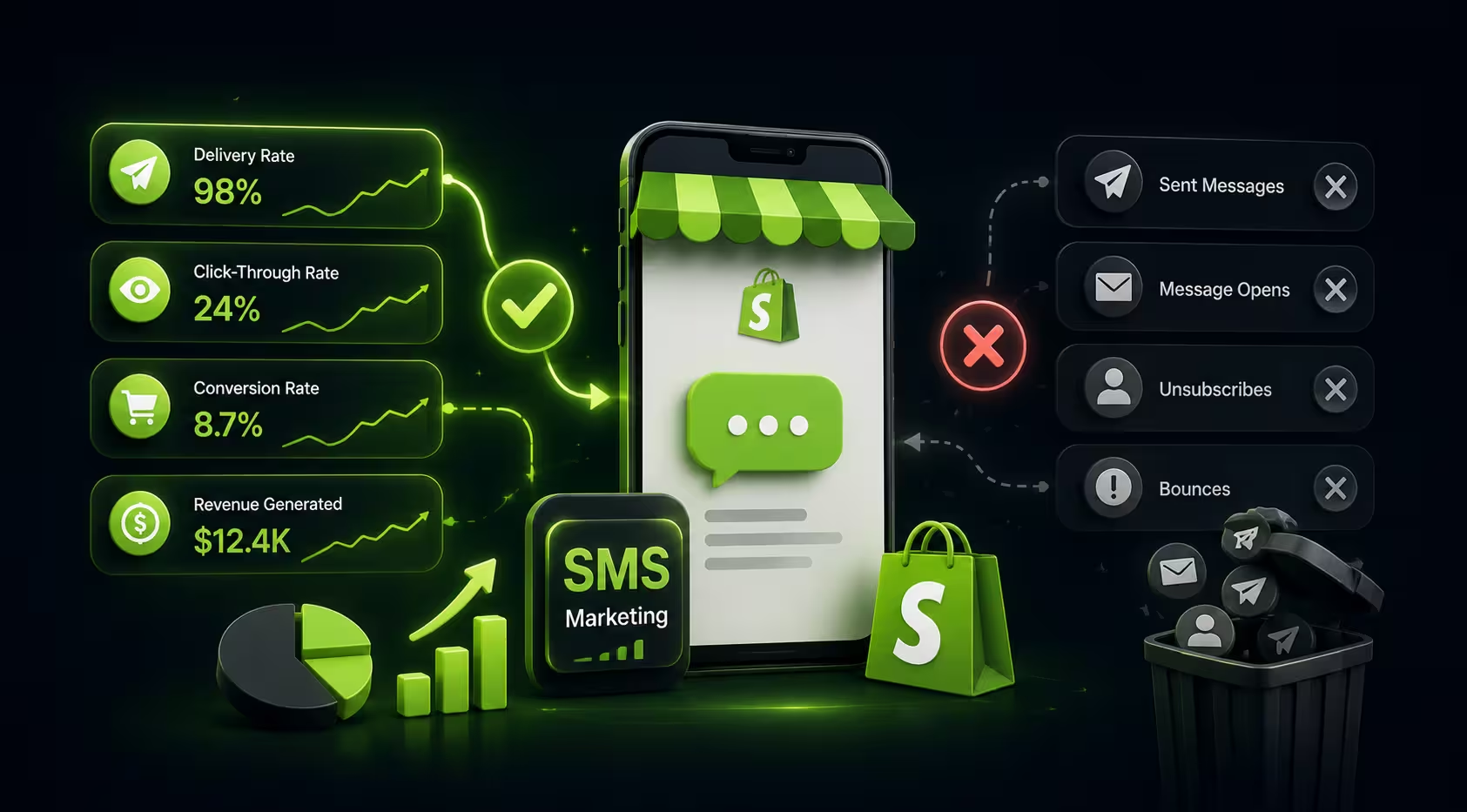
Here are your primary benchmarks to use as a guide:
Top-performing stores do not get these numbers through good fortune; they are consistently achieved through better segmentation, timing, and iteration.
Use them as diagnostic signals. If your CTR is lower than 8%, you need to adjust the copy or check your timing. If you are over a 12% opt-out rate, your messaging may be intrusive. And if revenue per SMS is less than $0.50, you should optimize your offer strategy.
Long story short, these benchmarks not only give you the performance, but they also tell you where to optimize next.
7 SMS Strategies to Reduce Shopping Cart Abandonment
SMS marketing has more than 90% open rates and (almost) instant visibility, allowing brands to re-enter shoppers’ minds while purchase intent is still active.
But just reminders won’t do the trick. The best brands use an approach that combines timing, personalisation, automation, and multi-channel coordination. Follow these seven best practices for recovering your carts for an increased ROI.
1. Build a High-Quality SMS Subscriber List
Everything starts with permission. Without a compliant and interested subscriber list, no abandoned cart SMS Shopify templates or strategies will work.
To grow your list effectively:
- Website pop-ups when users visit your website with clear value (discounts, early access)
- Add SMS opt-ins at checkout
- Create landing pages with incentives
A strong list gives you:
- Direct access to high-intent users
- Reliable first-party data
- Channel for real-time engagement
But remember, transparency matters here. Always communicate what they’re signing up for, and remind them that they can opt out at any time. This fosters trust and minimizes future churn.
2. Get Your Timing Right
Timing is one of the most important levers in SMS recovery. Intent wanes if your message comes too late, but if sent too early, it can feel intrusive as well.
Studies find that contacting customers in the first hour can recover a large percentage of lost sales.
Best-practice timing:
- Message 1 (15 to 20 min): Gently remind when the intent is still high. There is no need for a discount; merely a quick poke from the cart link will recover the customer.
- Message 2 (2 to 4 hrs): Add sense of urgency, social proof, or handling issues. Low-value baskets respond to small incentives
- Message 3 (22 to 24 hrs): Last chance with maximum offer and deadline.
Hence, the idea is to be present in their journey while keeping the product at the top of their mind. SMS is particularly effective here because messages are read in seconds, compared to email, which might remain unopened.
3. Automate Smart, Two-Way SMS Sequences
Cart abandonments are one of the simplest journeys to automate. Once a user falls off, you can trigger an SMS sequence that has already been built in advance using the abandoned cart SMS Shopify templates.
A typical high-performing flow includes:
- Message 1: Simple reminder
- Message 2: Urgency or reassurance
- Message 3: Incentive
Example:
- “Did you forget [product] in your cart?”
- “There are only a few left - don’t miss out.”
- “Here’s 10% off to finalize your order.”
Beyond automation, enable two-way communication. Broadcasting offers no room for customer response, while SMS becomes a conversation channel, significantly improving conversions.
4. Write Clear, High-Converting SMS Copy
SMS is a low-space but high-impact channel. Every word matters. See abandoned cart notification best practices for proven copy frameworks.
Effective SMS copy should:
- Be under ~160 characters
- Use simple, conversational language
- Include a clear call-to-action
- Create urgency or highlight value
What improves performance:
- Power words (“last chance”, “exclusive”)
- Numbers (“10% off”, “just 2 left”)
- Personal tone (“Hey Rahul…”)
Avoid overcomplicating your message. The aim is clarity, not creativity, for the customer. Even small copy tweaks can result in significant increases in click-through rate and conversion rates.
5. Use Incentives Strategically
Discounts can drive conversions, but if you do it right. See abandoned cart reminders best practices for how to build a discount ladder.
Common incentive types:
- Percentage discounts (10–15%)
- Free shipping
- Limited-time offers
- Bundled deals
Rather than leading with incentives, reward them throughout your sequence:
- First message: reminder only
- Second message: urgency or reassurance
- Third message: incentive
This shelters your margins and stops customers from abandoning carts on purpose to make themselves eligible for discounts.
6. Highlight the Abandoned Product
While there are plenty of great ways to pull back in users, showing them exactly what they gave up on is one of the best.
This works because it:
- Rebuilds product interest
- Reduces decision friction
- Recreates the original shopping intent
If your SMS platform supports it, add:
- Product image
- Product name
- Key benefit
Example:
“Still thinking about your sneakers? They’re running out 👀 Get yours here: [link].”
In particular, the combination of a visual cue along with an element of urgency drastically increases recovery rates.
7. Personalize Every Message
It is personalization that distinguishes good reminders from spam.
Use existing data to clarify your message:
- Customer name
- Product name
- Cart value
- Purchase behavior
You may also divide users into:
- First-time visitors
- Repeat buyers
- High-value carts
- Location-based audiences
Example:
“Hey Alex — your $120 cart is still here. Complete your order now and get free shipping.”
Customers are much more likely to engage and convert when messages feel relevant to them rather than a spam SMS.
7 Abandoned Cart SMS Shopify Templates (With Strategy + Examples)
A strong abandoned cart SMS Shopify strategy is not just about reminders; it’s about getting a sense for where customers fall off and responding with the appropriate message. Some forget, some are on the fence about price, and others need a nudge.
1. Gentle Reminder (Forgotten Cart)
This is most effective within 15 to 20 minutes of cart abandonment itself, while the shopper’s intent is still fresh. This is a soft, non-intrusive nudge that just reminds them about their cart while putting no pressure. Many customers abandon carts not because of disinterest, but because they got distracted; a well-timed reminder jogs their memory while the product is still fresh in their minds.
Example:
Hi [First Name], just a gentle reminder that your cart is still there waiting for you. Don’t miss out: [Cart URL]. Reply STOP to unsubscribe.
2. Free Shipping Incentive
These emails are best sent 2 to 4 hours after abandonment, and this email is one that is more value-based, removing barriers such as shipping costs. Customers drop off when they see unexpected fees, and hence giving a waiver on shipping fees will help you to convert them. See abandoned cart best practices for timing guidance.
Example:
Hi [First Name], we are keeping your cart safe! Enjoy FREE shipping on your order today: [Cart URL]. Reply STOP to end.
3. Discount Offer
This is most effective a few hours after abandonment, when an initial reminder has failed to convert. We are now focusing on creating a concrete incentive that nudges undecided customers to purchase. If discounts make price hesitation less of a problem than people respond, coupled with urgency, it leads to faster conversions.
Example:
Hi [First Name], here’s 15% off your cart! Use code SAVE15. Limited time offer: [Cart URL] Reply STOP to be removed.
4. Urgency + FOMO
To be consumed within 6 to 12 hours, this message establishes a sense of urgency and scarcity. The strategy is to elicit fear of missing out by emphasizing scarcity or urgency. This works because, when customers feel they may be losing that opportunity, they’re more likely to take action sooner. Pair with push notifications for even faster recovery.
Example:
Hey [First Name], your items are selling like hotcakes! Finish your order before they’re gone: [Cart URL]. Reply STOP to unsubscribe.
5. Cart Expiry Reminder
Usually used about 20 to 24 hours after the abandonment, it acts as a final push. It is using loss aversion to re-engage customers by reminding them that the items they selected may no longer be in stock. This is a powerful psychological trigger to finalize the purchase.
Example:
Hi [First Name], your cart is expiring soon. Don’t lose your items. Finalise your order now: [Cart URL]. Reply STOP to unsubscribe.
6. Invite Questions (Conversational Approach)
This message promotes engagement and creates a more personalized interaction, to be used within 2-4 hours. So the emphasis is on engagement; our customer feels heard and encouraged. This makes it very effective for products that need more thought before purchase.
Example:
Hey [First Name]! Your cart is waiting! Got questions? Just reply, we are here to help. Complete your order: [Cart URL] Reply STOP to unsubscribe.
7. Social Proof (Establish Trust & Credibility)
This works best about 8 to 12 hours after initial abandonment for customers on the fence about the quality or value of the product. The social proof will help to overcome indecision by revealing how many more people have purchased and loved the product. Social proof establishes credibility and assures the customer that they’re making a good decision, and it can have a dramatic effect on conversions. See proven abandoned cart email examples for more social proof tactics.
Example:
Hi [First Name], your cart is popular! Customers are loving these items. See why everyone’s buying: [Cart URL]. Reply STOP to unsubscribe.
These SMS cart recovery templates come in handy, but at the same time, implement timing, intent, and psychology to capture better conversions.
Shopify Flow + Multi-Touch Recovery
A strong abandoned cart SMS Shopify strategy works best with simple automation and multi-channel follow-ups (SMS, email, push).
Basic Shopify Flow trigger example
Trigger: Customer abandons checkout
Action:
- Wait 20 minutes
- Send SMS:
“Hi {{customer.firstName}}, your cart is waiting: {{abandonment.checkoutUrl}}”
With incentive logic
Trigger: Customer abandons checkout
Condition:
- Cart value > 75
Action:
- Wait 3 hours
- Send SMS:
“Enjoy FREE shipping today: {{abandonment.checkoutUrl}}”
Simple multi-touch sequence
An objection-based abandoned cart recovery sequence does so by countering objections with communications at the right time. After 15 minutes, send a soft SMS reminder to help re-engage distracted buyers. Send them a push at 3 hours after as a quick reminder to get back to you. If they have not yet converted, then send them an SMS after 8 hours with a discount or free shipping to combat their price apprehension. Then, 24 hours in, send an email as a final reminder that uses the last detail, plus trust signals and urgency to close the deal.
- 20 min – SMS (Reminder)
“Hi [First Name], your cart is still waiting: [Cart URL].”
- 4 hrs – Email (Value)
Subject: You left something behind [Include product details + reviews]
- 20 hrs – Push (Urgency)
“Your cart is about to expire. Checkout now: [Cart URL].”
This works by ensuring that SMS gets immediate attention, email catches you up on the context and reassures you to act quickly, and push notifications give a timely nudge at critical moments during your customer journey to raise recovery rates by addressing different parts of potential objections, and hence the customer is retained.
A/B Test Roadmap for Abandoned Cart SMS
The best abandoned cart SMS Shopify flows aren’t built on guesswork; they’re based on constant testing. Structured A/B testing is the only way to improve performance over time, because what works for one store does not work for another. Every shop has a different customer base; hence, intent, time, and segmentation keep on varying. The following is a prioritized roadmap:
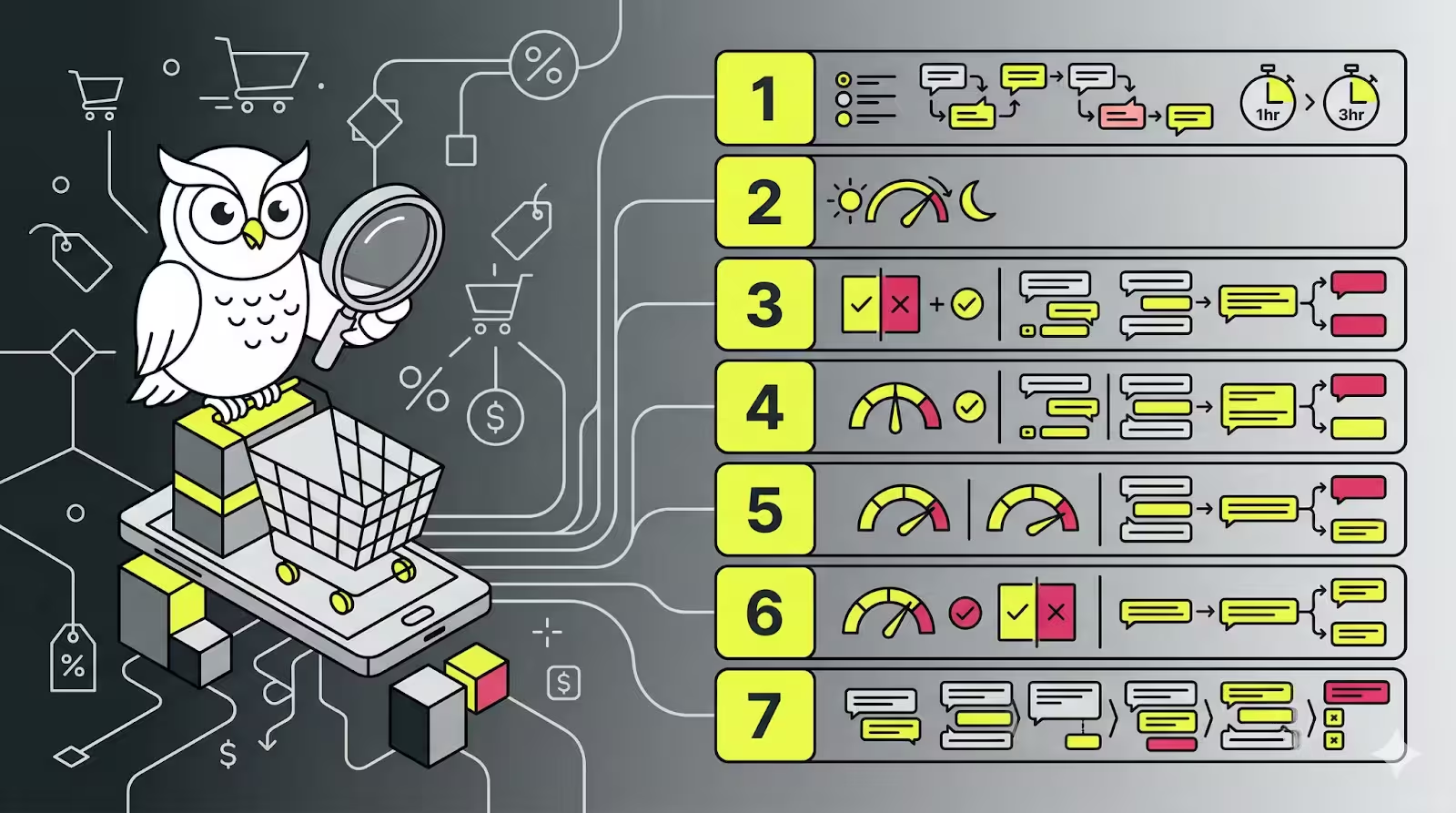
Test 1: Timing of First SMS
First, test when you send that first message (15 min vs 45 min post-abandonment). Timing is the single biggest factor, since it dictates whether you reach the customer while intent is still relatively high. Run this test first and measure at least 200 conversions per variant to find your sweet spot.
Test 2: With Discount / Without Discount
See if adding a discount in your second SMS increases results. One version uses urgency-only messaging, another has the 10% offer. While discounts may boost short-term conversions, they can affect long-term customer behavior, so be sure to monitor both recovery rate and repeat purchases.
Test 3: Personalization Depth
Look at shallow personalization (name + link) versus rich personalization (name and product name or cart value). Often, adding product details helps WISMO messages feel more relevant and can increase click-through rates.
Test 4: Emoji vs Plain Text
SMS texts with emojis versus clean, text-only messages. Emojis typically do best for lifestyle and fashion brands; simple text is better for luxury or high-consideration products. With results so variable, testing is the only solution.
Test 5: Loss vs Gain Framing
Test your offer presentation. So “Get 10% off” vs “Don’t miss your 10% off, expires soon.” Loss framing is usually more effective in SMS because it creates urgency and leverages the fear of missing out.
Always run each test on meaningful data, which is a minimum of 200 conversions per variant. Early decision-making may result in misleading outcomes and weaker long-term performance.
How Segmentation and Compliance Are Important For SMS (The PushOwl Difference)
An effective abandoned cart SMS Shopify strategy is not to send more messages, but smarter messages. One of the biggest mistakes businesses make is treating all abandoned carts equally. Segmentation is what differentiates a standard 4% recovery rate from a top-notch 10-12% flow.
Here is where tools like PushOwl come in very handy. While they’re traditionally known for push notifications, PushOwl allows merchants to create scaled recovery flows across multiple channels (with segmentation and timing working in concert).
Smarter Segmentation with PushOwl
PushOwl lets you segment users based on behavior and intent, so you can personalize messaging across channels:
1. Cart Value Segmentation
High-value shopping carts typically require reassurance and trust, while low-value shopping carts can often be resolved through urgency or additional small incentives. PushOwl lets you define different flows based on cart size so that each user gets the right message.
2. Customer Lifecycle Segmentation
Trust and incentives for first-time visitors; recognition and exclusivity for return customers. PushOwl helps you to reach out via SMS with push notifications and email, to keep the experience consistent and personalized on various touchpoints.
3. Product-Based Segmentation
Different products require different messaging. Consumables thrive on restock urgency, while high-consideration goods need social proof and reassurance. PushOwl assists in sending these messages and makes sure they get into the right hands through push reminders based on time, along with SMS.
The net benefit of layering these is that you have a more targeted experience with less friction, which directly leads to increased recovery and smaller opt-out numbers.
Compliance and Customer Trust
There is no SMS strategy without compliance. Sending unsolicited messages can have consequences and damage the reputation of your brand.
PushOwl enhances your SMS efforts with:
- Reducing over-reliance on SMS alone
- Enabling follow-ups via push notifications
- Aiding in remaining less disruptive while still keeping up the engagement
Why This Matters
Segmentation improves relevance. Compliance builds trust. And when paired with a multi-channel approach, which can be enabled using tools like PushOwl, you get a system that is both effective and sustainable for recovering lost sales.
Rather than bombarding customers with the same text over and over, you draw them back in at the best moment, on the right channel, with the message that resonates. Learn more about win-back campaigns and how omnichannel recovery compounds results.
Final Thoughts
The difference between a 3% cart recovery rate and a 12% one is not talent or budget; it is structure. While the abandoned cart SMS Shopify templates in this guide are designed to fill that gap, they’ll only do so when deployed within the segmentation logic that has them hitting the right person and the timing framework that gets them there before intent cools.
Start simple. Launch the universal first-touch template with a 20-minute trigger. Now, add high-value and low-value branches for your second message. Send a final recovery email at the 24-hour mark. Subsequently, run timing and personalization tests.
There’s so much performance data available after 30 days that you can make meaningful improvements, and every iteration from there on will be based on the behavior of your unique audience as opposed to someone else’s benchmarks. Tools like PushOwl make it easy to automate these flows across SMS, email, and push from a single dashboard.
The merchants that are recovering the most abandoned revenue aren’t sending better messages. They are conducting faster experiments, on cleaner slices of data, with a framework allowing for rapid learning. Now you have that framework too.