.png)

Email marketing statistics are everywhere.
Search for them, and you will find endless lists covering email open rates, ROI numbers, automation benchmarks, mobile usage trends, and more. But taken on their own, most of these email marketing statistics do not help you contextualize your Shopify store's campaign performance.
A 40% open rate might sound great until you realize that privacy features, such as Apple's Mail Privacy Protection, have inflated open rates across the industry.
A “$36 ROI for every $1 spent” headline is impressive, but it does not explain how that return is achieved or whether it is even a practical goal.
Statistics become useful only when tied to deliberate marketing decisions.
That is why this email statistics guide takes a different approach. Instead of listing random benchmarks, we have compiled 40+ email marketing statistics for 2026 and organized them around five questions that Shopify merchants ask most often:
- Is email worth investing in?
- Are my campaigns performing well?
- What should I automate?
- How should I send emails?
- Is my infrastructure sound?
Each section pairs the email marketing data with the context you need to interpret it. So, gather all the numbers and check how your campaigns can improve in 2026.
Question #1 For Shopify Stores: Should I Invest in Email?
When you have just opened your Shopify store, your first question might be, "Is email even worth investing in?”
You might be wondering whether it is better to go all in on ads with your marketing budget instead. But you do not have to rely solely on ads.
The average ROI for email marketing is $45 for every $1 spent in the retail/e-commerce sector.
That number comes from a combination of personalization and segmentation. To chase this kind of return on Shopify:
- Prioritize behavior-triggered flows consisting of 2-3 emails.
- Write catchy subject lines that combine urgency with relevance.
- Figure out the right time to send an email to a customer based on when they have opened previous emails (PushOwl helps with that!).
50% of consumers purchased directly from an email, thus confirming that email can drive sales.

Shoppers buy when the email matches their lifecycle stage and does not come across as salesy. When you are not relying solely on demographic segmentation, you can target your subscribers with offers that match their customer journey.
Email Marketing vs. Social Media Marketing
Social media is unpredictable, and you are at the mercy of a constantly changing algorithm.
Email marketing performs better than other marketing channels, with an average ROI of 3,500% compared to social media’s 250%.
Since you own the email list and have (hopefully) included only those who have consented, you have more control.
Focus on list growth, and keep updating those segments based on past purchase behavior.
Are Shopify Customers Even Using Emails?
Inboxes are crowded, yes, but these statistics signal that email still commands a high level of attention from users as the primary medium of digital communication.
The global number of emails sent and received each day is expected to reach 424 billion by 2028.
To cut through the noise, make sure your email copy is concise and mobile-compatible. The CTA should be clear, and your email subject line should not sound salesy; otherwise, your emails may be marked as spam.
62% of boomers and 51% of Gen X customers made a purchase from emails in 2024, making it the most popular marketing channel for both age groups.
If older cohorts are part of your target audience, this statistic is relevant to you.
These audiences check their email consistently and often have higher disposable income. You can match their high intent with trust signals such as reviews, UGC content, guarantees, and clear content.
Do I Need Emails for Higher Conversions?
Structured email campaigns lead to repeat purchases, which in turn compound revenue without increasing acquisition spend.
87% of marketing leaders say email is critical to their success.
Each email automation should tie back to a goal (e.g., increasing AOV) and a customer action (e.g., signing up for a loyalty program). If you cannot map these two parameters, you might have to revisit the email automation.
Get more conversions with behavior-based segments.
In 2026, layering email into your marketing efforts will help your brand.
PushOwl makes it easy with automations you can set up in minutes.
Question #2 For Shopify Stores: How Are My Emails Performing?
Once you have email marketing campaigns in place, the next obvious concern is whether you are getting your money’s worth.
Here are some benchmarks related to e-commerce metrics you can consider:
Open Rate Benchmarks
Email open rate benchmarks are a useful directional metric, but you need to understand their limitations.
However, open rates have become less reliable since Apple introduced Mail Privacy Protection (MPP), which automatically marks emails sent to Apple Mail as opened, even if a subscriber never opens them. Since Apple Mail accounts for a significant share of email clients, this artificially inflates reported open rates.
Keep this caveat in mind when looking at your email campaign’s open rates.
Click-Through Rate Benchmarks
Click-through rates measure the percentage of subscribers who click a link inside your email. This link could lead to a product page, a checkout page, an ad, or your Shopify website's homepage.
Abandoned cart automations, browse abandonment flows, and other automations are triggered by behavior.
Which means that a customer is more likely to convert and take advantage of the promo discount code if they were already browsing on your website, rather than a customer who receives a promo email out of the blue.
Conversion Rate Benchmarks
Your customers have opened the email and clicked on a link, but how many actually convert? Here are the conversion rate benchmarks you need to keep in mind:
The above rates may sound low, but remember, the conversion rate is calculated across entire sends. Regular promotional campaigns convert far lower than behavior-triggered emails.
According to Klaviyo’s Email Marketing Benchmarks 2026 Report:
- With automated flows, the average click rate across all industries is 5.58%.
- Top 10% of performers reach 10.48%.
The above difference is the entire argument for lifecycle marketing.
Meet your customers where they are, rather than spamming them with generic sales messages, and they will convert more.
If your email conversion rate is below 0.05%, you may need better customer-targeting strategies, or your traffic quality needs to improve.
Use this checklist to increase conversion rate:
Conversion rates improve when you optimize for timing and relevance, but also when you focus on reducing friction across the buying journey.
Other Key Metrics
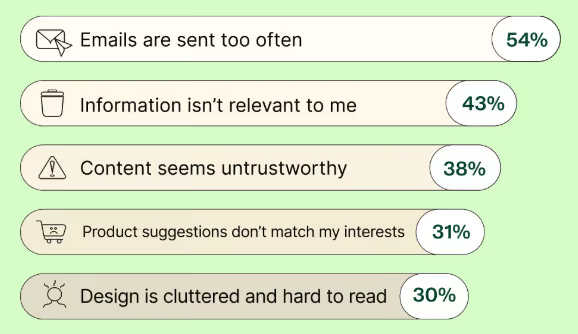
The previously mentioned metrics focused on who opens and engages with your emails and products. It is equally important to look at how many customers are doing the opposite, i.e., opting out or not engaging with the emails long enough.
The above figure is normal churn. But if you consistently exceed 0.3-0.5%, it is time to assess whether your messaging aligns with what your customers expect. High unsubscribe rate signals:
There is one more factor to consider: inbox placement. Bounce rate measures the percentage of emails that fail to be delivered.
The average bounce rate across all industries is 2.48%.
High bounce rates damage the sender reputation and signal email deliverability issues. To control bounce rate, avoid buying or using outdated email lists. Remember to run regular list-cleaning exercises to quickly remove invalid emails.
A bounce rate below 1% is excellent; 1-2% is good; anything above that needs investigation. - PushOwl Sales team
A related concept is a spam complaint threshold, which is the maximum % of emails that recipients can mark as spam before an email provider starts rejecting your emails or marking them as spam.
Google advises senders to keep their spam rate below 0.1% and prevent it from reaching 0.3% or higher.
Once you consistently cross that threshold, inbox providers start flagging your domain. If your customers are marking your emails as spam, assess the following:
When your customers feel that they are being misled, inundated, or forced to receive your emails, your spam complaint rate will shoot up.
With PushOwl, you can see the performance of all your marketing channels in real-time and on a single dashboard.
Question #3 For Shopify Stores: What Should I Automate?
Manual campaigns are fine, but why would you want to put in so much work when automations exist? We have already covered why email automations outperform regular promotional campaigns, but here is one more statistic:
Automation-based emails deliver 3x higher click rates and 13x higher placed order rates than regular promos.
Since automation triggers emails based on what customers are actually doing, such as browsing your e-commerce store, adding products to your cart, or running out of the products they purchased, you know exactly what to hit them with.
In 2024, automated emails accounted for 37% of all email-generated sales, despite comprising only 2% of email volume.
In other words, do not focus on send volume when planning your automations.
What is relevant is their timing. Your email should reach the customer within minutes of the relevant action, such as a welcome email sent right after they sign up for brand updates.
87% of automated orders stem from abandoned carts, welcome messages, and browse-abandonment emails.
Therefore, it is no surprise that the following are considered four must-have email automations among email marketers:
- Welcome automations
- Abandoned cart flows
- Browse abandonment flows
- Post-purchase emails
Why these specific automations?
Welcome Flows
When customers have signed up for your marketing emails or newsletters, their shopping intent is high, making it an excellent time to introduce your brand to them.
To maximize flow performance, do the following:
- Deliver the signup incentive or brand story to connect with your customers immediately.
- Introduce your best-selling products in the second or third email of your welcome flow.
- Space the emails over several days to ease the customer into the customer journey, rather than sending everything within 48 hours.
- On-board the customer with more details, such as store timings, product USP, etc.
With welcome emails, you can set the tone of your relationship.
Abandoned Cart Automations
Cart abandonment remains one of the highest-intent signals in e-commerce.
To recapture customers who abandoned their shopping carts, you need to effectively remind them of their chosen products without sounding spammy.
Send the first reminder within 30-60 minutes, and include key product details (such as the price and image of the product).
Do not include a discount in the first email; that’s a rookie mistake in ACR flows. Instead, include the incentive (discount, free samples, free shipping, etc) in the subsequent emails of the automation.
Post-Purchase Emails
Post-purchase emails can cover a variety of communications.
While some brands stop at only giving order updates after purchase, others include post-purchase support, usage tips, review requests, and even cross-sell recommendations.
To make your post-purchase automations engaging and relevant, focus on product education.
For skincare and makeup brands, this could mean usage and storage tips, skincare routine checklists, and ingredient breakdowns. For furniture brands, post-purchase flows could include cleaning and maintenance tips, as well as home decor inspiration.
Apparel brands could include styling inspiration and cross-sell product recommendations, such as matching footwear or a bag that goes well with the gown a customer just bought.
Post-purchase flows are also an excellent opportunity to roll out referral incentives and loyalty programs. Since the customer just bought from you, they are more likely to opt for these.
Transactional Emails
Transactional emails include operational messages such as shipping updates, order confirmation, payment receipts, and other delivery updates.
They may also include messages triggered by account-related actions, such as account creation confirmation, password resets, order cancellations, or refund notifications.
These emails are sent automatically after a specific user action, like any other e-commerce automation. But the goal is to communicate important information, rather than to promote products or drive engagement.
Since this information is something a customer is probably waiting for, such as an email confirmation after they create an account or refund updates, these emails have high open rates.
Transactional emails have an average open rate of 80-85%, much higher than regular marketing emails.
Transactional emails are an excellent opportunity to be playful with wording. Puns and jokes that match your brand’s vibe can elevate a boring operational email.
Let automations do the heavy lifting for you.
Question #4 For Shopify Stores: When and How Should I Send
Timing is everything when it comes to e-commerce emails. You do not want to flood your customers with emails all day, every day. Nor do you want to be so sparse with your messaging that they forget your brand.
33% of marketers send a general email marketing email weekly, while 26.7% send monthly promos. (Source)
But which day of the week should you send your emails?
Now, is there an ideal time to send a marketing email?
For e-commerce businesses, emails sent at 6 PM have the highest CTRs.
But you can take it a step further by tailoring the exact send time with our Smart Delivery tool. It identifies the exact time a customer will engage with your email and then sends marketing messages accordingly.
Every customer in your segment will receive emails at the precise time when shopping intent and attention are high.
To ensure that each of these email marketing campaigns is noticed, you need to focus on four main elements:
Engaging Subject Lines
Your email subject line is the first thing the customer sees and often determines whether they open it. With just a few words, you need to establish relevance and a connection.
It sounds counterintuitive, right? But personalization is not something you can communicate in limited characters, so it should not be the focus for a subject line.
Personalization comes through in your email segmentation tactics and the email copy, not the subject line. For clickworthy subject lines, follow this checklist:
Test your subject lines across various segments to zero in on what each cohort enjoys.
Advanced Segmentation
To personalize your email, you need to classify your customers into segments. Basic segmentation would involve dividing your customers by demographics and location.
Advanced customer segmentation requires dividing customers by specific behaviors. You can create the following segments:
- Cart abandoners
- High AOV customers/VIP Customers
- Discount hunters
- Seasonal shoppers
The sharper your customer segments, the more relevant your marketing content will be.
Tailored Content
Personalizing your emails goes beyond using your customer’s first name. You need to tap into what they need at that point in relation to their buying journey.
Brands that send personalized emails based on customer behavior achieve conversion rates ranging from 2.8x to 300.7x.
A product discount code won’t be effective if they know nothing about your brand.
Free shipping will not seem like an incentive if reliable reviews are what they need to see.
The goal is to match the message to the customer’s stage of intent.
For example, new subscribers respond better to brand intros and product education emails, while cart abandoners need reminders or small incentives to complete their purchase.
When your emails answer the question your customer is already asking, the personalization will land better.
Mobile Compatibility
When you are answering the “How Should I send emails?” question, you also need to look at where your customers will be reading your emails.
64% of email users check their emails on their mobiles.
Therefore, it is crucial to make sure your emails are optimized for mobile devices. Image-heavy emails or excessive formatting do not translate well in an email, which can lead to lower engagement and higher unsubscribe rates among mobile users.
When you shift your focus to the above factors rather than send volume, you will see your campaign performance improve.
Question #5 For Shopify Stores: Is My Infrastructure Sound?
Your email marketing campaign will be successful only if you have the right deliverability architecture in place. Even with the most persuasive copy and an engaging subject line, your emails might still go to spam due to poor authentication.
The average inbox placement rate is 75.6%. This means that 1 in 4 marketing emails never reach the inbox.
You need to monitor sender reputation to ensure your marketing emails reach subscribers' inboxes. Inbox providers review complaint rates and engagement patterns to assess your sender reputation.
And the bad news?
70% of emails show at least one spam-related issue.
One of the major culprits is failing to set up the following three authentications:
- Sender Policy Framework (SPF): List of approved sending IPs that can send emails from your domain.
- DKIM (DomainKeys Identified Mail): A security layer that prevents the doctoring of emails.
- DMARC: Lets you tell inbox providers to reject emails that were not sent from a trusted source, so that scammers cannot send spam emails using your domain.
If your emails are not authenticated, scammers can send phishing emails using your domain.
Another reason could be a stagnant email list.
When you are sending emails to customers who unsubscribed long ago, but you didn’t take them off your email list, they are likely to report your emails as spam, which will hurt your domain reputation.
Some brands also purchase email lists for their campaigns, meaning they are sending marketing content to cold leads who may never have heard of the brand and have not signed up for any emails.
E-commerce accounts for 27.3% of spam-category messages due to poor authenticity or purchased lists.
Paying attention to your sending infrastructure can build trust and, in turn, boost conversions. Fewer customers will report your emails as spam.And more emails will make it to your customer’s inbox.
Given the above, your email infrastructure is a key part of email marketing.
How PushOwl Helps You Beat the Benchmarks
PushOwl can help you beat industry benchmarks. When we roll out omnichannel strategies for our Shopify clients, they can see how each of their channels (email, SMS, and push notifications) performs, all in one dashboard.
Those marketing automation statistics we looked at? You can achieve them with pre-built campaigns that take minutes to set up.
One of our clients achieved 186x ROI with our automations, and segmentation efforts have led to 92x revenue growth for another. Want to achieve similar results for your brand?
Try our free plan, which includes 9,000 emails/month, and watch your store cross core benchmarks in 2026.