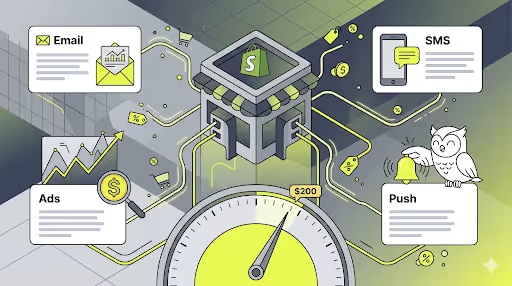
We have assembled three ready-to-deploy stacks for Shopify stores at different growth stages. Each one is assembled with exact monthly pricing, the automations that generate the most revenue at each tier, and realistic ROI estimates based on industry benchmarks.
Why Most Small Shopify Stores Overpay for Underperforming Tools
The average Shopify store running separate point solutions for email, SMS, and push is paying for three sets of contacts, three dashboards, and three attribution systems that do not talk to each other. The monthly cost stacks up fast, and the returns rarely justify the complexity. A store doing $30,000 a month in revenue does not need an enterprise marketing stack. It needs the right tools configured correctly and working together.
The good news is that a well-assembled omnichannel stack that covers email, web push, and SMS can be built for significantly less than $200 per month, with most of the revenue-driving automations available at or near the entry-level tier. The Shopify omnichannel marketing strategy guide covers why channel coordination matters more than channel count. This guide focuses on what that coordination actually costs.
Each of the three stacks below is built around PushOwl as the core platform for web push notifications, SMS, and omnichannel automation, paired with Brevo for email sending. PushOwl and Brevo operate under the same parent company (Brevo acquired PushOwl in 2022), which means their integration is deeper than a typical third-party connector. Contacts, segments, and automation triggers sync natively, which eliminates the attribution conflicts that typically come with multi-vendor setups.
The Three Stacks at a Glance
All three stacks assume a Shopify store with an existing customer base and a growing subscriber list. Costs shown are based on the tools' published pricing tiers as of early 2026 and will vary slightly based on contact list size and message volume.
Stack 1: The Lean Starter (Under $25/month)
Who This Is For
Stores generating under $10,000 per month in revenue that are setting up their first retention marketing layer. At this stage, the goal is to capture subscribers, get core automations live, and generate enough attributed revenue to justify moving to the next tier. This stack deliberately keeps scope narrow to make sure every tool is actually configured rather than installed and ignored.
The Tools
The Four Automations to Set Up First
With Brevo's free tier you get up to 300 emails per day and unlimited contacts, which is more than sufficient for a store under $10K/month. The free email marketing guide for Shopify covers exactly how to configure Brevo's free tier for Shopify, including transactional email setup and list sync. Pair it with PushOwl's Business plan for push notifications and you have two channels running for under $20/month.
Configure these four automations in this order:
- Welcome series (Email + Push): A two-email welcome sequence via Brevo triggered on new subscriber, plus a PushOwl welcome push notification fired 24 hours after opt-in. The welcome series is the highest-open sequence you will ever send. Do not skip it.
- Abandoned cart recovery (Push first, Email backup): PushOwl fires a push notification 30 minutes after cart abandonment. Brevo fires an email at the four-hour mark if no purchase. This two-channel sequence is the fastest path to measurable attributed revenue for a new store.
- Browse abandonment (Push only): PushOwl's browse abandonment trigger fires one push notification one hour after a product page visit with no add-to-cart. Low setup effort, consistent incremental revenue.
- Post-purchase email (Email only): A single Brevo email sent one day after delivery asking for a review. Establishes the feedback loop that powers your social proof and repeat purchase rate.
For the welcome series specifically, the Shopify welcome email examples guide has template structures you can adapt directly in Brevo. The abandoned cart reminders best practices post gives timing and copy guidance for the cart recovery sequence.
Expected ROI at Stack 1
At $19 per month in tooling cost, the payback on Stack 1 is typically measured in days, not months.
Stack 2: The Growth Engine ($60 to $110/month)
Who This Is For
Stores generating between $10,000 and $50,000 per month that have already validated their core email and push automations and are ready to add SMS as a third channel. At this stage, the priority shifts from first conversion to repeat purchase rate and increasing the percentage of revenue that runs on autopilot.
The Tools
PushOwl's SMS uses a pay-per-send model rather than contact-based pricing. For a store with a 1,000-person SMS list sending four to six automated sequences per month, the cost is typically in the $15 to $30 range. As your list grows, you are paying for message volume, not subscriber count, which means scaling your SMS list does not trigger the pricing step-ups that most SMS platforms impose. The SMS API guide for Shopify explains the underlying send infrastructure.
The Seven Automations to Configure
Stack 2 builds on the four automations from Stack 1 and adds three SMS-specific sequences:
- Welcome series (Email + Push): Already running from Stack 1.
- Abandoned cart (Push + Email + SMS): Add SMS as the third leg. Fire push at 30 minutes, email at four hours, SMS at 24 hours if still abandoned. The three-channel sequence consistently outperforms two-channel by 30 to 50% on recovery rate.
- Browse abandonment (Push + SMS): Add a one-hour SMS to the existing push sequence for high-intent product page visitors who have not opted into push but have given SMS consent.
- Post-purchase SMS flow: Three messages: order confirmation (immediate), delivery follow-up plus review request (day after delivery), cross-sell recommendation (day 14).
- VIP winback (SMS + Email): Target customers with three or more orders who have not purchased in 90 days. SMS on day one with an exclusive offer, email follow-up on day three if no conversion.
- Segmented email campaigns (Brevo): Move from broadcast campaigns to segmented sends using Brevo's audience builder. Minimum two segments: active purchasers (last 90 days) and lapsed subscribers (90 to 180 days).
- Retargeting (Google Ads, optional): A small Google retargeting campaign (under $50/month) targeting store visitors who did not opt into any channel. This is the only paid channel in this stack and is optional for stores where organic and retention channels are already performing.
For the segmented email layer, the email segmentation guide for Shopify covers Brevo-compatible segment builds in detail. The lifecycle segmentation framework gives the strategic layer for deciding which segments get which send cadence.
Expected ROI at Stack 2
At $60 to $110 per month in tooling cost, the ROI multiple on Stack 2 ranges from roughly 17x to 66x. The ceiling expands significantly once the VIP winback and segmented campaigns are dialled in.
Stack 3: The Full Stack ($140 to $185/month)
Who This Is For
Stores generating $50,000 per month or more that have a functioning retention program but want to close the remaining gaps: loyalty mechanics, social proof collection, and more sophisticated audience segmentation. At this tier the goal is compounding repeat purchase rate and building the data infrastructure that increases store valuation.
The Tools
Brevo's Business plan at this tier unlocks advanced automation workflows, A/B testing on email sequences, and higher monthly send volume without per-email overage charges. For a store doing $50K+ per month with a list of 5,000 to 15,000 contacts, the Business plan typically prevents the overage costs that make the Starter tier more expensive in practice.
The Full Automation Suite
Stack 3 runs everything from Stack 2 and adds four more sequences:
- Loyalty tier upgrade notifications (Push + Email): When a customer crosses a purchase threshold that earns them a new loyalty status, PushOwl fires a push notification immediately and Brevo sends a detailed email explaining their new benefits. Loyalty tier notifications have some of the highest open rates of any triggered message.
- Back-in-stock alerts (Push + SMS + Email): Triggered when a waitlisted product is restocked. Push fires first (instant), SMS second (one hour later if no click), email third (four hours later). Back-in-stock sequences consistently generate revenue at a cost near zero since the customer already expressed intent.
- Advanced post-purchase flow (Email + SMS, 30 days): A structured 30-day sequence that moves customers from first-time buyers into the repeat purchase cohort. Includes cross-sell recommendations, review requests, loyalty program enrollment, and a 30-day win-back trigger if no second purchase has occurred.
- Shopify Flow cross-channel triggers: Use Shopify Flow to fire PushOwl events based on custom metafield updates, fulfillment status changes, or tag assignments. This enables sequences like "push notification when a VIP order ships" or "SMS when a loyalty reward is about to expire" without manual intervention.
The Shopify Flow and web push integration guide shows the exact Flow trigger setup. For the review and UGC collection layer, the best Shopify apps for product reviews compares the main options at the $10 to $20/month price point.
Expected ROI at Stack 3
Stack 3's ROI multiple remains strong despite the higher tool cost because the additional sequences (back-in-stock, loyalty tier, advanced post-purchase) tap revenue streams that are otherwise completely uncaptured. The loyalty and back-in-stock automations in particular run at near-zero marginal cost once configured.
Side-by-Side Stack Comparison
The ROI multiples converge at higher stack tiers because tool cost grows proportionally with the additional channels and sequences. What expands is absolute revenue contribution, not the multiple. A Stack 3 store generating $18,000/month in attributed automation revenue on $159 in tooling is still running an extraordinarily efficient program.
When to Move Between Stacks
The most common mistake is either staying on a lean stack too long (leaving SMS and advanced segmentation revenue on the table) or jumping to a full stack before the foundational automations are consistently generating revenue. Use these signals to time your stack upgrade:
Move from Stack 1 to Stack 2 when: Your abandoned cart push and email recovery sequences are generating consistent attributed revenue each week, your email list has crossed 1,000 active subscribers, and you are seeing customers who opted into push also converting on email. At that point, adding SMS as a third channel has a ready audience and a clear incremental upside.
Move from Stack 2 to Stack 3 when: Your three-channel automation suite (email, push, SMS) is running reliably, your customer database shows a meaningful cohort of buyers with two or more orders, and you are starting to see diminishing returns on broadcast campaigns because your segments are not refined enough to keep engagement high.
If you are unsure which tier fits your current store, the ecommerce metrics for store health guide gives the KPI benchmarks (repeat purchase rate, LTV, subscriber growth) that correlate with each growth stage. The ecommerce strategy for Shopify post covers the broader channel strategy context for each stage.
Swap-In Recommendations
The stacks above are optimized for the PushOwl and Brevo ecosystem, which is the tightest native integration available for Shopify push plus email. If you have specific constraints, here are the most common swap scenarios:
If you are already on Klaviyo for email: Keep Klaviyo and add PushOwl for push and SMS. PushOwl integrates with Klaviyo via native connector, syncing segments and suppression lists bidirectionally. Your email stack cost will be higher than Brevo, but your existing flows remain intact.
If you want email but have zero budget: Shopify Email (included free with Shopify) handles up to 10,000 emails per month at no cost. It lacks advanced automation, but for Stack 1 stores that are not ready to invest in Brevo, Shopify Email covers broadcast campaigns and basic transactional sends while PushOwl handles the automation layer.
If you want to add paid ads without breaking the budget: At Stack 2, a $30 to $50/month Google retargeting campaign targeting store visitors who have not opted into any channel adds a cost-effective fourth touchpoint. Facebook/Instagram retargeting at the same budget level is viable but more competitive for small Shopify stores in most niches.
For a broader comparison of email marketing tools that sit at similar price points to Brevo, the email marketing platform comparison for Shopify and the best email marketing apps for Shopify guide both cover the field in detail.
Stack Setup Checklist
Regardless of which stack you choose, the setup order matters. Complete each step before activating any sends:
- Step 1 - SMS and email compliance: Configure opt-in capture with proper consent disclosures. PushOwl handles TCPA-compliant SMS opt-ins natively. Review the SMS consent requirements for Shopify brands before your first send.
- Step 2 - UTM parameters: Set a consistent UTM naming convention across all channels (utm_source: email / sms / push) before any automations go live. Retroactively fixing UTMs on active campaigns is time-consuming and creates attribution gaps.
- Step 3 - Suppression lists: Configure cross-channel suppression so a customer who converts on push does not immediately receive the SMS and email versions of the same sequence.
- Step 4 - Core automations: Launch welcome series and abandoned cart first. These two sequences generate the fastest payback and prove the channel ROI before you invest time in more complex flows.
- Step 5 - Baseline metrics: Record your pre-stack revenue, repeat purchase rate, and average order value. You need a baseline to measure the stack's actual impact at the 30 and 90-day marks.
For more detail on building an email list that powers all three channels in these stacks, the email list building guide for Shopify covers both opt-in mechanics and list health practices. The web push notification subscriber growth guide does the same for the push channel.
The $200 Budget Constraint Is Not a Limitation
Merchants who have run enterprise-tier marketing stacks at $1,000 or more per month frequently find that the Stack 2 or Stack 3 configurations above generate comparable attributed revenue. The reason is that most of the revenue generated by omnichannel programs comes from a small set of high-performing automations, not from the breadth of the toolset.
Get the abandoned cart sequence, the welcome series, and the post-purchase flow running correctly on two or three channels, and you will have covered the majority of the revenue opportunity that most stores leave uncaptured. Everything beyond that is incremental improvement, and the PushOwl and Brevo ecosystem is designed to grow with you without changing platforms as your volume scales.