Why Small Shopify Stores Are Betting on SMS in 2026
SMS marketing has one metric most other channels cannot match: a 90%+ open rate, with the majority of messages read within three minutes of delivery. Email, for comparison, typically lands between 20% and 30%.
For small Shopify stores running lean, this matters operationally. You are not competing on ad spend. You are competing on relevance and timing, and SMS is one of the few channels where a store with 200 subscribers can outperform a brand with 20,000 if the automations are set up correctly.
The challenge is not whether SMS works. It is choosing the right tool without locking into enterprise pricing you cannot yet justify.
Before you pick a tool, get clear on SMS consent requirements for Shopify brands. Compliance is not optional, and it directly affects which platforms you should shortlist based on their opt-in flow design.
This guide covers eight affordable SMS tools, what they actually cost at small list sizes, how long setup takes, and the ROI you can realistically expect in your first 30, 60, and 90 days.
What "Affordable" Actually Means for a Store Under $20K/Month
For a store with fewer than 500 SMS subscribers and under $20,000 in monthly revenue, affordable means four specific things:
- A free plan or a genuinely useful trial that does not require a credit card
- A base price under $30/month at entry level
- Per-message or per-credit pricing that does not penalize list growth
- A clear path to break-even within 30 to 60 days of activation
That break-even point is the real test. A tool priced at $19/month that recovers a single $200 cart in week one pays for itself 10x over. The question is how fast you can build the automations that make that happen.
For context on how SMS integrates with your broader channel stack, see how email-to-text and text-to-email work and what is an SMS API in Shopify before finalizing your platform selection.
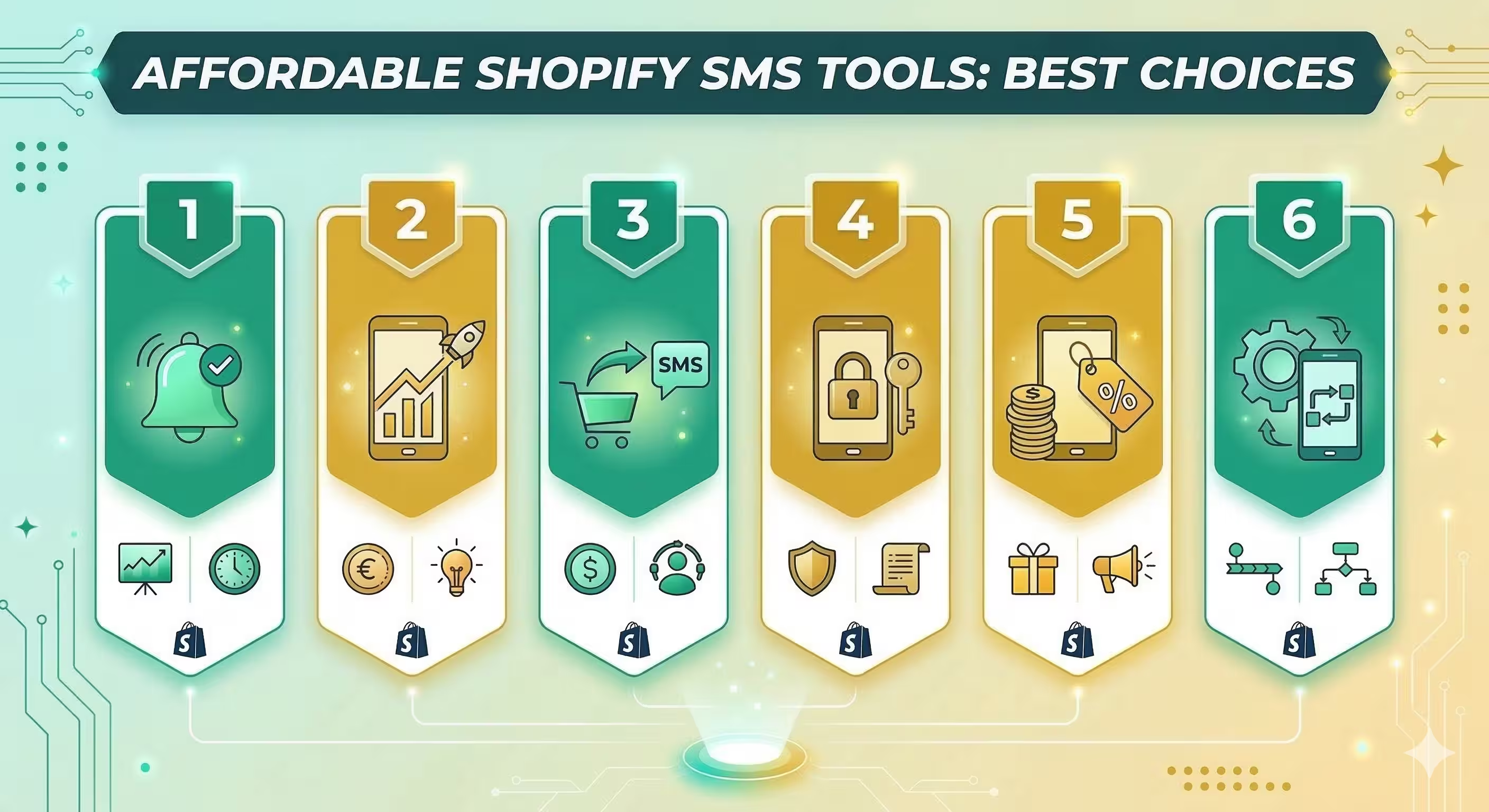
The 8 Best Affordable SMS Tools for Shopify (2026)
1. Postscript
Best for: Stores Launching SMS for the First Time
Pricing: Free plan available; paid from ~$25/month plus usage fees
Setup time: 20 to 30 minutes
Break-even list size: ~150 subscribers with a basic abandoned cart flow
Postscript is built specifically for Shopify, which means zero compatibility friction and first-party data sync from day one. Abandoned cart and welcome flows are pre-built, and most merchants have their first automation live within a single session.
The free plan lets you test the channel before committing to a paid tier. For stores still validating whether SMS fits their customer base, this is a meaningful advantage.
30/60/90 ROI: By day 30, most stores recover one to three carts per week through automated flows. By day 90, subscriber counts typically reach 300 to 500 via checkout opt-ins and pop-ups, at which point the compounding effect on cart recovery becomes clearly visible in revenue.
Best for: First-time SMS users who want a clean, Shopify-native experience without any technical configuration.
2. PushOwl + Brevo
Best for: Omnichannel Reach on a Minimal Budget
Pricing: PushOwl free plan available; paid from $9/month. Brevo SMS from ~$25/month
Setup time: 20 to 30 minutes for web push; additional 15 minutes to connect Brevo SMS
Break-even list size: ~100 web push subscribers to start. No SMS list required to begin generating revenue.
This combination deserves special attention from small stores. PushOwl adds web push notifications as a third marketing channel alongside email and SMS, and the operational difference is this: web push subscribers opt in with a single browser click. No email address. No phone number. You can be reaching a marketing-active audience from day one, even before your SMS list has meaningful size.
When layered with Brevo's SMS capability, you get a genuine omnichannel setup at a fraction of what bundled enterprise platforms charge. More practically: if a customer misses your SMS, a web push notification can still reach them on their next store visit. That redundancy is something single-channel setups simply cannot replicate. PushOwl's pricing model also reflects its design philosophy, with no contact-based pricing that penalizes list growth.
30/60/90 ROI: Web push typically generates measurable click-through revenue within the first two weeks. By day 30, the push plus SMS combination creates channel redundancy that lifts overall campaign reach noticeably. By day 90, the multi-touch attribution picture clarifies and informs exactly where to invest further.
Best for: Small stores that want maximum reach across multiple touchpoints without per-contact fees on every channel.
Related:
Web push notification examples |
Shopify omnichannel strategy |
SMS and push combined strategies
3. TxtCart
Best for: AI-Powered Cart Recovery
Pricing: Commission-based (percentage of recovered revenue); monthly plans from ~$29
Setup time: 15 to 20 minutes
Break-even list size: ~50 subscribers (the commission model requires minimal upfront commitment)
TxtCart uses conversational AI to follow up with cart abandoners through two-way SMS, simulating a real customer service interaction. The commission model is worth understanding in detail: if TxtCart does not recover revenue, your cost is minimal. This makes it genuinely low-risk for stores still deciding whether SMS fits their audience.
For stores with cart abandonment rates above 65% (close to the industry average), TxtCart tends to show the fastest payback of any tool on this list.
30/60/90 ROI: Attributed recovery revenue is visible from day one because of the commission structure. Stores pairing TxtCart with a standard email abandoned cart sequence consistently see stronger combined recovery rates than either channel alone.
Best for: Stores prioritizing cart recovery ROI who want to minimize upfront financial risk.
Related:
Abandoned cart email examples for how email and SMS combine to improve overall recovery.
4. Klaviyo SMS
Best for: Stores Already Running Klaviyo Email
Pricing: SMS credits from ~$15/month, bundled with email plans
Setup time: 15 minutes (for stores already on Klaviyo)
Break-even list size: ~200 SMS subscribers
If you are already running Klaviyo for email, adding SMS is a one-click unlock. Flows, segments, and all customer data are shared across both channels, meaning no duplicate build work. You extend what you already have rather than starting from scratch with a second platform.
The combined cost of email plus SMS on Klaviyo is frequently cheaper than paying for two separate platforms, which matters when you are watching every line item.
30/60/90 ROI: Day 30 is about layering SMS into existing email flows and measuring channel-specific lift. By day 60, you have enough data to understand whether your audience responds better to SMS or email nudges within the same automation sequence.
Best for: Shopify stores already invested in the Klaviyo ecosystem who want to extend reach without a new vendor.
Related:
Email marketing automation for ecommerce for building flows that connect both channels coherently.
5. Omnisend
Best for: Freemium Multi-Channel Bundle
Pricing: Free plan includes 60 SMS per month; paid plans from ~$16/month
Setup time: 30 to 40 minutes
Break-even list size: ~150 subscribers
Omnisend packages email, SMS, and web push into a single platform. For stores that have not yet committed to a channel mix, the free tier lets you run limited tests across all three simultaneously without paying a monthly fee.
The multi-channel sequencing is where Omnisend earns its place on this list. A coordinated sequence (email on day one, SMS follow-up on day three) consistently lifts abandoned cart recovery rates compared to single-channel approaches at comparable cost.
30/60/90 ROI: Multi-channel sequencing delivers measurable lift within 30 days. By day 90, you have clear read on which channel combination your specific audience responds to most reliably.
Best for: Stores that want to test email plus SMS together before committing to a paid plan.
Related:
Customer segmentation on Shopify to build the audience structure that makes multi-channel targeting worthwhile.
6. Avada Email Marketing and SMS
Best for: Absolute Beginners
Pricing: Free plan available; paid from ~$16/month
Setup time: 15 to 20 minutes
Break-even list size: ~100 subscribers
Avada strips back the complexity that makes most marketing platforms feel overwhelming to first-time users. The SMS functionality covers the fundamentals: welcome messages, order notifications, abandoned cart recovery, and basic promotional blasts. No deep automation logic is required to get started.
The interface is designed for merchants who find most Shopify marketing apps visually dense. Getting SMS active quickly, with zero learning curve, is the primary value proposition here.
30/60/90 ROI: Lower ceiling than more advanced tools, but perfectly adequate for early-stage validation. Most stores break even within 45 to 60 days based on cart recovery alone.
Best for: New Shopify merchants who want SMS active quickly without any technical complexity.
7. Sendlane
Best for: Data-Driven Decision Making
Pricing: From ~$25/month for combined email and SMS
Setup time: 30 to 45 minutes
Break-even list size: ~200 subscribers
Sendlane positions itself as a unified revenue platform, combining email, SMS, and reviews under one subscription. Its attribution reporting is cleaner than most competitors at this price point, making it straightforward to understand which specific channel is driving conversions and which is costing money without a return.
For stores that have moved past the validation stage and want to make confident, data-driven decisions about their channel mix, Sendlane provides the reporting infrastructure without requiring a custom analytics setup.
30/60/90 ROI: Cleaner attribution means faster iteration cycles. By day 60, most merchants have a confident view of their channel weighting and can begin scaling what is working with real data behind the decision.
Best for: Stores ready to move from intuition-based to data-driven channel decisions.
Related:
Ecommerce metrics for store health |
Top ecommerce metrics to track for the framework that makes attribution data actionable.
8. SMSBump by Yotpo
Best for: Automated Flow Depth
Pricing: Free plan available; paid from ~$19/month
Setup time: 30 to 45 minutes
Break-even list size: ~100 to 200 subscribers
SMSBump has one of the most generous free tiers in the Shopify SMS space and a flow builder that covers the core automations small stores actually need: welcome series, abandoned cart, post-purchase, and win-back sequences. Shopify customer segments sync natively, so list growth happens automatically as customers check out.
The depth of its automation library outpaces most tools at this price point, making it a natural step up for stores that started on a simpler platform and need more sophisticated sequences.
30/60/90 ROI: Abandoned cart recovery is typically measurable by day 30. Post-purchase flows start contributing to repeat purchase rates by day 60. By day 90, segmented campaigns outperform broadcast blasts by a visible margin on click-through rate.
Best for: Stores that want automation depth without paying enterprise prices.
Related:
Win-back campaign examples for Shopify to see how SMS fits into re-engagement flows.
Your 30/60/90 Day SMS ROI Roadmap
Regardless of which tool you choose, small Shopify stores following a structured activation approach tend to see revenue in a predictable sequence.
Days 1 to 30: Activate your first automation, typically abandoned cart plus welcome. With an SMS cart recovery rate of 5% to 8%, a store sending 100 abandoned cart messages per month at a $60 average order value can expect $300 to $480 in recovered revenue in month one alone.
Days 31 to 60: Layer in a post-purchase flow and run your first promotional campaign to your opt-in list. Repeat purchase rate typically improves by 10% to 20% once post-purchase SMS is live.
Days 61 to 90: Introduce segmentation. Buyers versus non-buyers, high-AOV customers versus one-time purchasers. Segmented SMS campaigns consistently outperform broadcast blasts by two to three times on click-through rate. See lifecycle segmentation for Shopify and market segmentation vs customer segmentation for the audience architecture that makes segmented SMS work.
Quick Comparison: 8 SMS Tools at a Glance
| Tool |
Starting Price |
Free Plan |
Best For |
Setup Time |
| Postscript |
~$25/mo + usage |
Yes |
New stores |
20-30 min |
| PushOwl + Brevo |
From $9/mo |
Yes |
Omnichannel reach |
20-25 min |
| TxtCart |
Commission-based |
Yes |
Cart recovery ROI |
15-20 min |
| Klaviyo SMS |
~$15/mo add-on |
No |
Klaviyo users |
15 min |
| Omnisend |
~$16/mo |
Yes |
Email + SMS bundle |
30-40 min |
| Avada |
~$16/mo |
Yes |
Absolute beginners |
15-20 min |
| Sendlane |
~$25/mo |
Trial only |
Data/attribution |
30-45 min |
| SMSBump |
~$19/mo |
Yes |
Automation depth |
25-35 min |
Three Things to Do Before You Launch SMS
1. Get consent right. TCPA and GDPR compliance is not optional and the penalties are not proportional to store size. Read the SMS consent guide for Shopify brands before collecting a single phone number.
2. Understand what sits under the hood. If you are evaluating developer-friendly setups or want to understand how SMS platform pricing connects to message delivery, what is an SMS API in Shopify is worth 10 minutes before you sign up for anything.
3. Build an omnichannel stack, not a single-channel one. The stores seeing the strongest SMS ROI pair it with email and web push to create multi-touch sequences. See the ecommerce strategy guide for Shopify and email marketing platform comparison for Shopify for how the full channel picture fits together.
.png)