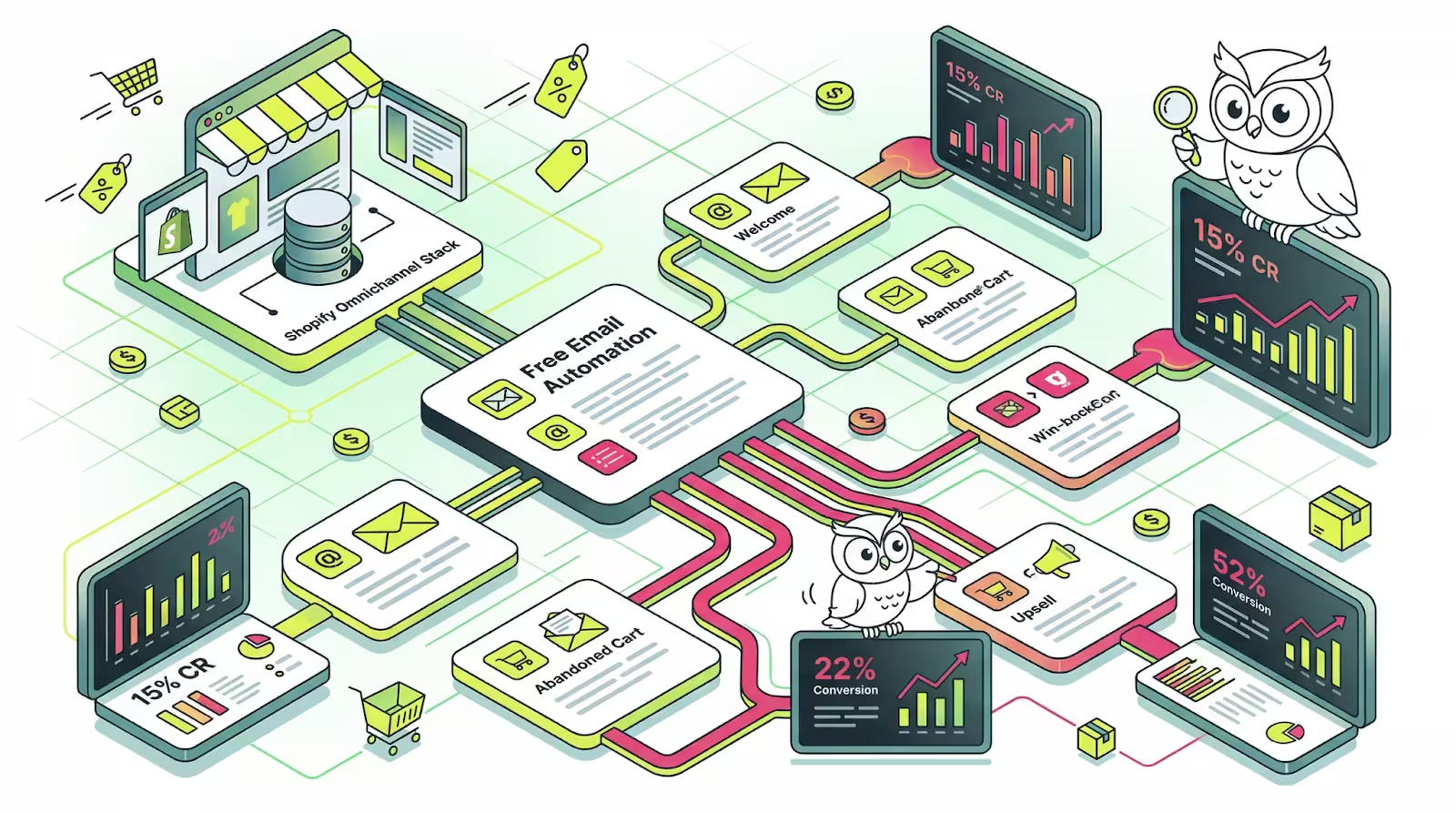
Most Shopify store owners either pay too much for email tools they don’t know how to use, or avoid automation altogether because it sounds complicated. Email marketing continues to return an average of between $36 and $42 for every $1 spent, and that figure stays stable in 2026, despite the rise of paid social and influencer marketing. What has changed is accessibility. You can now create an entire email automation system for your Shopify store that helps you rake in revenue, without spending a single dollar on software.
But the “free” pricing layer has contact limits, automation restrictions, and missing features.
We’re covering 10 of the best free email automation tools for Shopify in 2026, what you really get without a payment, and the actual conversion numbers Shopify merchants are hitting, not juicy headline stats, but metrics you can actually compare your own store to.
Why Email Automation Is Non-Negotiable for Shopify Stores in 2026
Email marketing is when you send out a weekly newsletter. That’s fine. But email automation is a different beast altogether.
The best part of automated emails is that they are triggered based on what your customer does or doesn’t do. They arrive in the inbox just when they are most well-timed: when someone leaves a cart, makes a first-time purchase, hasn’t bought anything for 90 days, or subscribes to your list for the very first time. That timing is everything.
They receive an email when they abandon a cart after 45 mins, which prompts them to complete the purchase because the product is likely still on their mind. A welcome email that triggers the moment someone subscribes. The only way these moments are possible is through automatic actions.
The other advantage is compounding. Once your flows are live, every new subscriber or customer is automatically routed through them. You build it once; it works forever. For a growing Shopify store, that means funds are coming in through the email channel 24/7 without anyone on your team laying a finger.
Real Conversion Numbers You Should Actually Benchmark Against
Before diving into the tools, here’s what really matters. These are the averages from industry reports and platform benchmarks for 2025 and 2026, far from best-case scenarios.
Abandoned Cart Emails: 39 percent to 45 percent average open rates. The recovery rate is the percentage of recovered orders relative to shopping carts left on your site and averages 5 to 11 percent. So, a sequence of three emails (30 min, 24hr, 72 hr) will always outperform just one. The initial email by itself accounts for 50 to 60 percent of all recoveries.
Welcome Email Series: Average open rates of 50 to 60 percent, and the highest of any email type. On average, a three-part welcome series converts 3 to 5 percent of new subscribers into first-time buyers (with well-optimized sequences reaching 8 to 12 percent).
Email After Purchase: Open Rates from 40 to 55 percent. Good post-purchase flows can convert 2-4 percent within 30 days and up to 8-12 percent for stores with rock-solid follow-up sequences.
Win-back campaigns: 12 to 18 percent open rates on lapsed subscribers. Getting 4 to 8 percent back in an active purchase cycle is considered strong performance, and the ROI is high since the acquisition cost has already been sunk.
The Top 10 Free Email Automation Tools for Shopify in 2026
Let’s see the best email automation tools to optimize your Shopify store traffic into revenue. And with so many “free” options out there, it’s all too easy to choose one that looks good on paper but fails when you actually start scaling. This list helps you find truly useful tools without paying up front.
1. Brevo PushOwl : ‘Best Overall Value’ for Shopify Stores
Ratings: 4.8/5 (1,500+ reviews across platforms)
Pushowl works best for Shopify stores that want email, web push, and SMS to be as seamless and easy to implement, and that too, all from a PushOwlsingle e-commerce-specific platform
If you want the easiest possible balance of value and price, it’s PushOwl. It was purpose-built for Shopify merchants, not repurposed from a one-size-fits-all email tool. The difference is evident throughout the experience of various Shopify merchants.
What differentiates PushOwl from the other tools on this list is its channel mix. Most email tools provide you with the email, and that’s it. PushOwl combines email, web push notifications, and SMS into a single dashboard, with three engagement channels working together under one roof. That’s not a small thing. Web push notifications serve as a backup for customers who do not open emails. Let’s consider SMS for customers who miss both. More touchpoints through the right channel at the right time lead to more recovered carts and repeat purchases, improving overall retention, without running these as three separate tools.
One such feature that needs to be addressed here is Web push notifications. Browser notifications appear on desktop and mobile, regardless of whether the customer is in their inbox, and they have a 10x higher click-through rate than traditional email for time-sensitive triggers such as flash sales, back-in-stock alerts, and price-drop notifications. Stacking email behind push in the same abandonment flow yields much better recovery rates than either channel alone.
Since its merger with Brevo, the PushOwl platform has added depth in email automation from segmentation and flow builders to campaign analytics, while retaining the simplicity that made it the push notification tool of choice for Shopify merchants in the first place.
The Shopify integration is seamless. It takes minutes to install from the app store, and PushOwl automatically pulls in your product catalog, order history, and customer behavior data. Abandoned cart recovery, welcome series, post-purchase sequences, browse abandonment, and win-back campaigns are pre-built automations for these scenarios, and others come ready to deploy within minutes (not hours).
Key Features:
- All in one dashboard, like Email, Web Push, and SMS
- Pre-built e-commerce automation, such as abandoned cart, welcome, post-purchase, win-back, and browse abandonment
- Intelligent segmentation using purchase history, browsing behavior, cart value, and engagement frequency
- Import products in one click directly from Shopify, including images, prices, and links automatically
- Dynamic content blocks that change based on each customer’s data
- Dedicated IP option with 98%+ Inbox placement rate
- A/B test subject lines, content templates, and send times
- Revenue attribution analytics that clearly show how much each campaign or automation generates
- 24/7 customer support from real people and not bots
Real Results from Shopify Merchants:
Shopify merchants using Pushowl achieve cart recovery rates of 8-14% on average, well above the industry standard for email-only tools. The average web push click-through rate for abandoned cart notifications is 15-25%. Average click-through on Welcome automation engagement rates top 20 percent. Stores that combine all three channels see 30-40% higher recovered revenue from abandonment flows than stores operating email alone.
Pricing:
Free plan to start. Paid plans scale with usage and enable full automation across all touchpoints.
Ideal for:
Any Shopify store, whether it’s brand new or well-established, that wants a single platform managing multiple engagement channels, without the enterprise-level complexity and expense.
2. Klaviyo: The Go-To Tool for Dynamic Analytics and Segmentation
Rating: 4.7/5 (Over 2,300 reviews on Shopify)
Klaviyo is the solution for data-driven stores with at least 1,000 subscribers needing advanced segmentation and don’t mind a learning curve.
Klaviyo is the most recommended email platform in the Shopify ecosystem for good reason. If you want to go 100% in on data-driven email marketing, Klaviyo offers the deepest segmentation options and most powerful automation builder on the market.
What Klaviyo does best is turn data into revenue. You can create segments like “VIP customers who spent over $500 in the last 90 days,” or “customers who bought once but haven’t returned in 45 days,” with only a few clicks. Because your emails tie back to what specific customers actually did, what they viewed, added to cart, purchased, or left behind, they feel obviously personalized rather than generic.
Klaviyo does this by tracking every customer interaction from across your store in real-time and using that data to automatically trigger automations. Browse a product without buying? You receive a browse abandonment email. Add to cart and leave? Cart recovery flow fires. Complete a purchase? Post-purchase sequence starts. Now, you might ask, how does all this work without manually touching any of them once your flows are configured?
It has the most powerful flow builder in any pricing tier. Branching logic, conditional splits, time delays, email goal tracking, and A/B testing within automations are all available on the free plan; you’re only limited by the ceiling of contacts, not feature sets.
Key Features:
- More than 350 pre-built integrations
- Sophisticated predictive analytics, such as churn risk scoring and CLV forecasting
- A/B Testing for Subject Lines, Content, and Send Times
- Data-driven dynamic content blocks
- SMS marketing included
- Shopify sync in real-time for every product view, purchase, and cart event
Pricing:
Free for up to 250 contacts, and paid plans begin at $20 a month and increase with your contact list.
Ideal for:
Medium to large SF-based stores with 1K+ subscribers who need advanced targeting, and are willing to invest time into learning the tool.
3. Shopify Email: The Native Solution More Powerful Than Most Merchants Think
Rating: 4.5/5 (Built into the Shopify admin)
Shopify email works best for new stores that want core automations to be live in a day with zero integration friction.
Shopify Email has also quietly evolved into a bona fide automation platform. What was once a simple newsletter tool now has automation templates for abandoned checkout, welcome sequences, win-back campaigns, first purchase upsells, and browse abandonment, all within your Shopify admin and with no separate login.
The automation builder is linear (not branching), so you cannot build complex conditional logic. For most stores in their early years, however, that really isn’t a constraint. It manages five core types of automation that each cover the workflows generating by far most email revenue for most Shopify stores.
The beauty of Shopify Email is the zero-friction setup. Since it’s native to Shopify, your product catalog, customer data, and order history are already present. Products can be inserted right into emails with a single click. Analytics reside in the same dashboard you use to manage everything else.
Key Features:
- Built-in Shopify integration, and no configuration or API setup needed
- Custom-made templates for abandoned checkout, welcome, win-back, and post-purchase
- Drag-and-drop insertion of products from your Shopify catalog
- Shopify customer data synchronized as segmentation
Pricing:
Free, up to 10,000 emails per month. $1 for every 1,000 emails over that, and is considered among the lowest overage charges in the market.
Ideal for:
New Shopify stores that want no setup friction and core automations working within just hours.
4. Omnisend: E-commerce Focused and Multichannel From Day One
Rating: 4.7 out of 5 (Over 5,800 reviews on Shopify)
Small Shopify stores are looking for both email and push from a solution built solely for online retail find this tool very useful. Omnisend is purpose-built for e-commerce, not reusing technology built for general marketing. Every feature reflects that. These automation templates include abandoned cart, welcome series, order, and shipping confirmations, birthday emails, and sales sequences. Generic contact forms are not how people purchase retail, and so the flows are built around real retail purchasing pathways.
The Product Picker allows you to drag products straight from your Shopify catalog into emails with images, prices, and links all included without any copy-pasting required. Dynamic discount codes (one per recipient, not shared across all, as you see with some other platforms) are available on the free plan, which is rare and genuinely useful for cart recovery and win-back flows.
Web push notifications are free alongside the email on your free plan, so you have two active channels at the same time. Omnisend’s own benchmark data indicates automations account for an average of 31 percent of total email revenue among stores on the Shopify platform, which is non-negotiable for the Shopify Merchants.
Key Features:
- Product Picker to directly integrate with the Shopify catalog
- Free plan includes personalized, unique discount codes per recipient
- Template automations for all core e-commerce workflows
- Web Push Notifications are free for a certain limit
- Multi-channel focused and integrates SMS, email, and web push
Pricing:
Free for up to 250 contacts and 500 emails per month, and paid plans begin at $16 a month.
Ideal for:
Shopify stores with fewer than 250 subscribers that need a real e-commerce automation backbone from day one.
5. Brevo: Best Free Plan for Larger List Size and Medium Sending Volume Stores
Rating: 4.5/5 (Across 1,900+ reviews)
Stores with growing contact lists that’d like to add contacts without investing like Brevo. Brevo turns upside down the pricing model that most email tools follow. They bill based on emails sent rather than contacts stored. If you have a big list but your email volume is moderate, this model will save you real money compared to contact-based pricing.
The headline feature is unlimited storage for contacts. For stores that are in the process of building their list via pop-ups, lead magnets, or offline channels but haven’t yet sent high-volume campaigns out, the free plan from Brevo could potentially last longer than nearly any alternative.
E-commerce triggers are well tackled by its automation builder, as all flows for abandoned cart, welcome, post-purchase, and re-engagement work with the free plan. By offering built-in CRM and transactional email features, it offers usability beyond just automation. The setup requires a bit more configuration than native Shopify tools, though the documentation is well-written.
Key Features:
- Free plan with unlimited contact storage
- Marketing automation with e-commerce triggers
- Built-in CRM functionality
- Transactional email and SMS (pay-per-send)
- A/B testing on campaigns
Pricing:
Unlimited contacts, and free up to 300 emails daily (around 9,000 each month). Higher volume paid plans start from $25 per month.
Ideal for:
Stores with a massive list but email infrequently and don’t want to pay per contact.
6. Sender: Best Generous Free Contact and Sending Limit
Rating: 4.6/5 (Across 1,200+ reviews)
In terms of raw limits, the sender has the most generous free tier of any tool on this list. 2,500 subscribers and 15k emails per month are more than enough for a store doing several thousand dollars a month in revenue to run full automation sequences over all core flows. Growing stores that want full-on automation without hitting paywalls before they’ve proven ROI find this tool quite useful.
This tool handles abandoned cart, welcome series, browse abandonment, birthday emails, and custom triggers. Web push notifications are grouped with email. They have built-in pop-up and form builders to grow your list. The integration for Shopify takes a little more configuring than native solutions, but it works consistently when it’s up.
Design customisation is solid rather than particularly extensive, and support on the free plan is restricted to email only. But for the scale of what you get without paying, the sender is consistently the most underrated option in this space.
Key Features:
- 2,500 subscribers, 15,000 emails per month on free plan
- The complete automated workflows for all fundamental e-commerce triggers
- Web push notifications included
- Building lists with pop-ups and a form builder
- Subscriber segmentation and analytics dashboard
Pricing:
Free for up to 2,500 subscribers and 15k emails per month. Pricing starts at $15 a month for more credits and features.
Ideal for:
Businesses running between 0 and 2,500 subscribers that want a fully free automation setup with plenty of room to grow.
7. Mailchimp: Known UI, Significant Free Plan Restrictions
Rating: 4.3/5 (Across 2,400+ Shopify reviews)
For years, Mailchimp was the default email tool, and it’s still used by many Shopify merchants due to familiarity. The interface is very clean and easy to use, and the email builder lets you create clean professional designs with relative ease. It works well for stores that are already using Mailchimp for another business and want to consolidate under a familiar tool.
But there is one very important limitation: you can’t do abandoned cart automation without upgrading to a paid plan. You have to be on at least the $13-per-month business essentials plan to access it. Cart recovery is the single highest-ROI automation for most Shopify stores, so this is a pretty big constraint if you’re sticking to free.
What you get on the free plan excludes things like an email series (you can only send one): welcome message, basic segmentation, landing page, campaign analytics. For stores that are very early on and have not yet reached automation depth, it does the job. But once cart recovery becomes a priority, you’ll have to upgrade your plan or switch tools.
Key Features:
- Professional templates with polished email builder
- Simple welcome automation on the free plan
- Landing pages and forms included
- Campaign analytics
Pricing:
Free for up to 500 contacts and 1,000 emails per month. Paid plans start from $13 per month, which is needed for abandoned cart automation.
Ideal for:
Stores already on the Mailchimp ecosystem that aren’t actively prioritizing cart recovery automation yet.
8. ActiveCampaign: Most Capable Automation Builder, Trial Only
Rating: 4.6/5 (800+ reviews across Shopify)
Free plan: 14-day trial only (no permanent free-tier)
ActiveCampaign doesn’t offer a permanent free plan, but the 14-day trial gives you access to the most powerful automation builder on the market. For stores that know they will end up investing in email seriously, using the trial to really get a handle on what it is like to use the platform adds a lot of real value.
This works great for stores ready to pay to invest in serious automation infrastructure, and has the best visual flow builder. The visual automations builder is a drag-and-drop and supports branching logic, conditional splits, goal tracking, loop prevention, and lead scoring, all in the same flow editor.
This also includes predictive sending (i.e., the platform chooses the best send time for each contact). It is deeply integrated with Shopify, and the integration is also real-time.
ActiveCampaign is especially useful for stores handling high-value customer relationships along with marketing automation, as the CRM is available on all plans. The paid plans begin at $15 a month for the Lite tier after you’ve tried it out with your trial, but for the full depth of e-commerce automation, then Plusplan is needed.
Key Features:
- Assembly visual automation builder with branch logic
- Per-contact predictive send time optimization
- Rich Shopify integration with up-to-the-moment behavioral data
- Full CRM included in every plan
- Scoring leads and tracking goals in automations
Pricing:
14-day trial. Paid plans start from $15 a month with a lite plan; full e-commerce features from $49 a month with the plus plan.
Ideal for:
Stores with a budget to spend on looking for the most powerful automation architecture possible.
9. Drip: E-commerce Focused, With a Very Limited Free Option
Rating: 4.4/5 (600+ Shopify reviews)
Free tier: 14-day trial only
Drip is also built exclusively for e-commerce stores, which means its behavioral segmentation features are one of the best. You can segment by purchase frequency, average order value, product category preferences, engagement level, and predicted churn risk, and trigger automations based on any permutation of those attributes.
It works great for stores with a strong product catalog and that need sophisticated behavioral segmentation. The Shopify integration pulls your entire product catalog and purchase history, and pre-built e-commerce workflows address every primary automation type. The email builder isn’t too advanced, but it is flexible. Where Drip earns its credibility is in how granularly it can target stores with big catalogs and disparate customer segments to get the most revenue.
One major hurdle is that there is no permanent free plan available. Paid plans begin at $39 a month for up to 2,500 contacts after the 14-day trial. For stores of that size with consistent revenue, the investment makes sense.
Key Features:
- Advanced behavioral segmentation for e-commerce
- Key automation types supported with out-of-the-box Shopify workflows
- A visual automation builder with branching logic
- Full product catalog integration
- Detailed revenue attribution analytics
Pricing:
14-day free trial. Pricing for paid plans starts at $39/month for up to 2500 contacts.
Ideal for:
Established Shopify stores with large catalogs that require granular targeting based on behavior.
10. Privy: Best Free Option for List Building Combined With Basic Automation
Rating: 4.6/5 (25,000+ Shopify reviews)
Privy is the most widely installed conversion tool in the Shopify App Store, and for good reason. Its core strength is list building, such as exit-intent pop-ups, spin-to-win wheels, announcement bars, and embedded forms, all of which work on the free plan regardless of traffic volume. New stores that want to grow their list and run basic welcome and cart recovery automations together find Privy very useful.
On the email automation side, the free plan covers up to 100 mailable contacts with basic automation, including abandoned cart and welcome emails. The cart abandonment email feature is available without paying, a direct contrast to Mailchimp. For stores just getting started, the combination of powerful list-building tools and basic automation in one place reduces the number of apps you need to install.
The email builder is simple rather than sophisticated, and automation depth doesn’t compare to Klaviyo or Pushowl. But Privy’s value is the combination: grow your list with pop-ups, nurture with basic email automation, all in one lightweight app.
Key Features:
- 25,000+ Shopify reviews and the most reviewed conversion tool in the App Store
- Exit-intent pop-ups, spin-to-win, and embedded forms are free for all traffic
- Abandoned cart and welcome automation are available on the free plan
- Easy setup with no technical configuration required
- Basic segmentation and campaign analytics
Pricing:
Free up to 100 mailable contacts and pop-ups. Paid plans start at $30 per month.
Ideal for:
Brand new Shopify stores that want to build their list and run basic automations from one simple app.
When to Upgrade & Why Email Automation Still Wins in 2026?
Free plans are a starting point, not a permanent strategy. Upgrade when your email automations are generating more than $500 per month in attributable revenue. At that point, a $30 to $50 per month paid plan pays for itself many times over. Upgrade also when you need A/B testing inside automation flows, advanced branching logic, predictive analytics, or seamless SMS integration alongside email.
The tool matters less than actually setting up the automations. A basic abandoned cart flow in Shopify Email or PushOwl that’s live today will outperform a perfectly designed Klaviyo flow that never gets deployed. Pick a tool, get your core five automations running, and let the revenue data tell you when it’s time to move to a more powerful plan.
Email isn’t going anywhere. In a world where paid ads keep getting more expensive and social media reach keeps shrinking, owning a channel where you can reach your own customers for free is more valuable in 2026 than it has ever been.